Showing posts with label biodiversity study. Show all posts

Friday, April 02, 2021

Butterfly identification course


As summer gets closer, we can look forward to watching the butterflies flit around and through our gardens, writes Brian Byrne. Wouldn't you like to know how to identify them?

Well, the National Biodiversity Data Centre is running a free online course for people to learn to do just that.

The course is suitable both for those completely new to the topic, or who want to brush up on their identification skills.

It can be used in conjunction with butterfly identification swatches used in the field, which can be bought from the NBDC's shop.

The course is available here

Photographs use Policy — Privacy Policy

Monday, August 21, 2017

Live and learn — the Grasshopper Warbler

Did you know that there is a bird called a Grasshopper? writes Brian Byrne.

Well, I didn’t until I perused the sign at the Main Street entrance to The Valley Park earlier this year, which signposts the bird life along the river in Kilcullen.

The Grasshopper is a warbler, and rarely seen. But he is one of the no less than 21 bird species resident along the banks of the Liffey which can be walked by the general public in Kilcullen.

The sign, erected by Kilcullen Community Action with the help of grants from Kildare County Council and the Local Agenda 21 Environmental Partnership Fund, also notes three other types of bird which are regular visitors to the area.

A number of other local information signs are at the completed design stage and will be installed in due course.

They are based on information gathered in the course of the Biodiversity Survey 2013 which was commissioned by KCA and produced with the help of Leader.

Tuesday, August 23, 2016

About Kilcullen's biodiversity

Walking along the Bridge Nature Trail over the weekend I was reminded of some of the tiny beautiful gems of biodiversity we have along the Liffey banks in the town, writes Brian Byrne. Also how fortunate we are to have it all well documented.

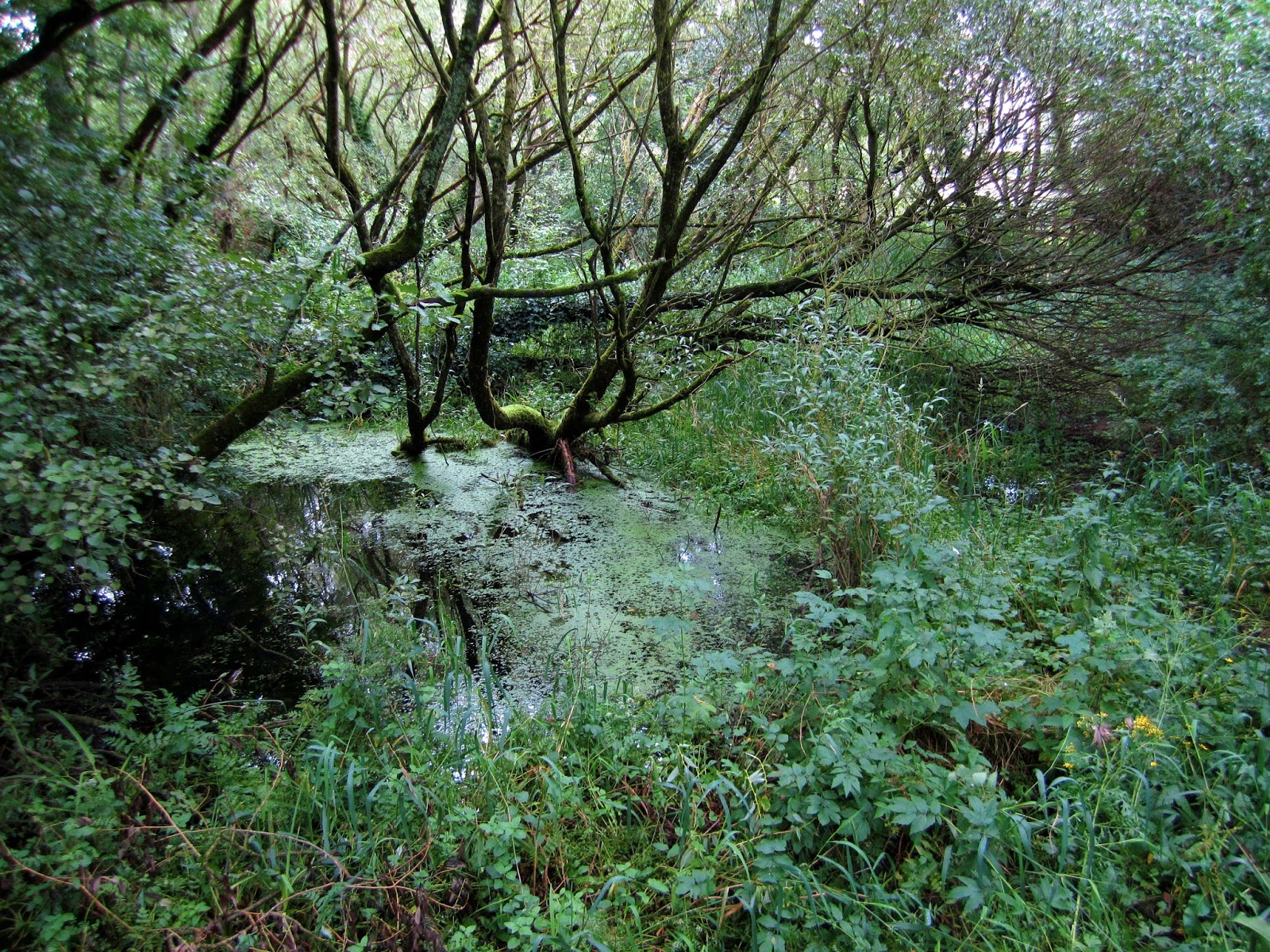
It's just three years since the 'Biodiversity Survey of Liffey and Environs in Kilcullen', by Dr Mary Tubridy and Associates, was launched here. Among the many bits of fascinating information was how the picture above represents a now scarce representation of typical Ireland riverscape in pre-history times. It's a microcosm of wild wet jungle where you can just imagine a dinosaur or two plunking around in the mud ...

That Survey was undertaken at the behest of Kilcullen Community Action, with support from Kildare Leader, and during its preparation in 2012 there were several 'Wild Weekend' events to involve the public, adults and children, in the exercise. Remember the 'Bat Night'? And the 'Bird Walk'? Super events. Maybe it's time to repeat them?

There are a number of stories I wrote from various segments of the Survey Report, which those of you not familiar with how Kilcullen was and is in geological, flora and wildlife terms might like to look back at.

In the meantime, for those who want to delve into the source material, the documents relating to the Survey are available for download at the link on the Kilcullen Community Action website here.


Saturday, October 10, 2015

Biodiversity signage grant for KCA

Kilcullen Community Action has received a grant of €1,000 under the Local Agenda 21 Environmental Partnership Fund, for the provision of biodiversity signage, writes Brian Byrne.

The Fund, which has operated since 1997, promotes sustainable development by assisting small-scale environmental projects at local level. These projects involve partnership arrangements between local authorities and various local groups including community groups, schools and environmental NGOs.

The grant was made under the category Development of Community Areas including Wildlife and Biodiversity.

It's understood that the estimated cost of the signage is €1,500, and the grant being paid represents €500 each from Kildare County Council and the Environmental Fund.

Kilcullen Community Action commissioned a major Biodiversity Study of the Liffey area in Kilcullen in 2012 and the consequent Report was launched in 2013. The provision of signage resulting from the information gleaned in that Study has been an aim of KCA since.


Sunday, March 23, 2014

Clearance work in Valley

Work commenced yesterday to remove overgrown bushes and trees from the upper slopes of the valley, writes Jim Collins. This work was recommended in a survey done last year.

The clearance will give a better view of the valley, the river and the Canoe Club from the Church road. The cut material is now filling the upper pathway which will be closed to the public.

It may take a few weeks to remove this greenery.

Pictured are Tommy Dillon and Jim Collins.

Thursday, September 12, 2013

Author of Biodiversity Study on radio tonight

Dr Mary Tubridy will be speaking on KFM Radio tonight about the Biodiversity Survey which was recently produced for Kilcullen Community Action, writes Brian Byrne.

The Survey, produced with the financial help of the County Kildare Leader Partnership, examined the plant and animal life around and in the River Liffey as it flows through Kilcullen.

Dr Tubridy led a team of experts in the various disciplines for the Survey, which lays down a benchmark from which to protect the river environment for future generations.

She will be speaking on KFM between 8-9pm.

Thursday, September 05, 2013

Kilcullen 'fortunate' in river environs

Town 'fortunate' in wetlands, grasslands, woodlandsKilcullen is fortunate to have a number of very good wetlands in its environs, according to Dr Mary Tubridy who directed a Biodiversity Survey of the area at the behest of Kilcullen Community Action, writes Brian Byrne.

In a chapter on Habitats and Plants, her Survey reports that such wetlands elsewhere have often been eliminated by drainage, reclamation or building development.

No less than 114 kinds of wild plants were recorded in the Survey, growing in 22 different kinds of habitat in the research area.

Dr Tubridy says that the town is also fortunate to have both dry and wet broadleaved woodlands around the town.

A number of grassland areas, including one near the ecologically important reedswamp close to the Mill Stream confluence with the Liffey, have a high degree of biodiversity.

Details of at least 30 different plant species on that grassland can be found in the Survey, which also makes suggestions as to how this diversity can be maintained and enhanced, even in private gardens.

Wednesday, September 04, 2013

Public urged to learn further on biodiversity

More to learn from SurveyOne of the key targets of conducting the recently-published Biodiversity Survey of the Liffey in Kilcullen was to involve the local community, writes Brian Byrne.

With last year's Wild Weekends as part of that, it was a target well achieved. But more is possible.

In every chapter of the Survey, Dr Mary Tubridy has provided suggestions for getting further information on the specific chapter themes. These are aimed both at adults and young people, and include directions to other reading, websites, and making direct field observations.

These are well worth looking at to identify a project for kids in school, or for further education of adults themselves, and will serve to make even more awareness of how fortunate we are in Kilcullen to have the Liffey flowing through the town, and that it is in a healthy state.

We can't afford to take that for granted. Our waterways and the life — animal and plant — which depends on them are always in danger of attack from a variety of sources. Don't depend on the authorities to make sure they are protected ... we have as much, or more, responsibility ourselves to ensure that our future generations of Kilcullen people can enjoy what we have today.

So, as a first step, read the Survey and its associated reports. They're not heavy, and in many ways quite fascinating. You can access them on the KCA website.

Tuesday, September 03, 2013

Good bats population in Kilcullen


Include largest bat species in IrelandFive of the 11 species of bats found in Ireland can be found in Kilcullen, according to the Biodiversity Survey of the Liffey and Environs in Kilcullen, writes Brian Byrne.

The Survey details the kind and features of the ones found here, noting that one of them is the largest bat in Ireland, the Leisler's bat.

A Bat Walk was one of the 'Wild Weekend' events held last year as part of the public involvement in the Survey, which also offers hints to keeping the area bat-friendly.

Monday, September 02, 2013

Lots of birds in Kilcullen

Observed on survey walkSome 35 different kinds of birds are listed in the Biodiversity Survey commissioned by Kilcullen Community Action, writes Brian Byrne.

They were noted by ornithologist Tom Cooney in his walks along the banks of the Liffey through Kilcullen and include many native species such as tits, the blackbird and robin. Summer visitors include swallows and martins.

The Survey says only five of the species were found on the river. It provides a good explanation of how interlinked the environmental habitats and food chain in the area is.

The Survey was directed by Dr Mary Tubridy and was produced with the help of funding from the Kildare Leader Partnership.

Wednesday, August 28, 2013

Rare and protected fish 'abundant' in Kilcullen

Crayfish a good signMost people in town might not know it, but Kilcullen has an abundance of a fish that is quite rare and is protected by national and EU legislation, writes Brian Byrne.

It's the crayfish, which resemble small brown lobsters and grow to about 10cm in length.

According to observations in the Biodiversity Survey directed by Dr Mary Tubridy during 2012, the crayfish are mainly active at night and in the summer months.

Eating snails, insect larva and sometimes their own young, in turn they provide a food source for other water life including salmon, trout, pike perch and birds like the heron.

The Survey, commissioned by Kilcullen Community Action, offers detailed information on the plant and other life in and around the River Liffey as it flows through Kilcullen.

As a report card on the environmental health of the Survey area, it gives high marks, although a number of elements need to be maintained or improved in order to ensure the continuing health of one of Ireland's most important ecological 'corridors'.

Dr Tubridy notes that it is 'rare' to have a clean river with abundant wild habitat flowing through a town in Ireland these days.

Tuesday, August 27, 2013

Mini Beasts prowl the Liffey

Lots of life in riverShould you be worried that there are in the region of 60 species of 'Mini Beasts' roaming in and around the river areas of Kilcullen, writes Brian Byrne?

Not really, as that's the categorisation of a range of insects and other life detailed in the Biodiversity Survey directed by Dr Mary Tubridy and commissioned by Kilcullen Development Association.

They include stone flies, mayflies, beetles, snails, clams and worms. Kilcullen has 14 of the 31 Mayfly species that occur in Ireland, according to Noreen McLoughlin MSc, who carried out a Biological Survey as part of the overall work.

Biodiversity Survey of the Liffey and Environs in Kilcullen is a treasure trove of information on Kilcullen's flora and fauna, and indicates a very healthy situation for the local fish and bird life. The Survey was launched last weekend.

It's worth a read if only to provide an appreciation for the importance and fragility of our local environment and how much it is worth protecting.

Saturday, August 24, 2013

Biodiversity Survey is launched

That the soil in and around Kilcullen is very productive is thanks to an ice sheet that brought limestone 'till' to the area as it moved in from the north-east, writes Brian Byrne.

That's another nugget from the Biodiversity Survey commissioned by Kilcullen Community Action and launched in report form at an event in Kilcullen Heritage Centre last night.

The Survey, by Dr Mary Tubridy and Associates, delves into the geological underpinnings of the modern Kilcullen as well as detailing the diversity of the flora and fauna in and around the River Liffey as it flows through the town.

The Survey notes that the underlying rocks, greywackes, shales and siltstones, are all quite acidic and wouldn't have provided good farming soil.

Those rocks, formed in the Silurian Period some 400m years ago, can be seen in the scarp opposite the Bridge Camphill lands, and on Knockaulin. They are also visible in a number of old stone walls such as in the graveyard, and in the old part of the bridge.

The geology of Kilcullen and its formation played an important part in the development of the modern environmental network that provides habitats and food to a wide variety of life in and around the river area through the town.

The monolith of glacial gravels at the east end of the Valley Park is an 'unusual relic' of the Ice Age, Dr Tubridy notes, and suggests that we 'look closely' to find other monoliths in the same Park.

Dr Tubridy's Survey makes suggestions for further information gathering by interested local people.

After last night's launch there was a walk through the Valley and the Camphill Nature Trail.

The documents relating to the Survey are available for download at the links below.

Biodiversity Survey of the Liffey & Environs in Kilcullen. Mary Tubridy and Associates.

Geological Geodiversity around the town of Kilcullen, County Kildare. Dr Robert T Meehan, PGeo.

Biological Survey of the River Liffey and its Tributaries in Kilcullen, Co Kildare. Noreen McLoughlin, MSc.

Bird Survey at Kilcullen, County Kildare. Tom Cooney.

Habitats and Plants Survey. Mary Tubridy.

The Valley Riverside Walk, Kilcullen: Guidelines to Enhance Biodiversity and Amenity. Dr Betsy Hickey.

Bats Survey (later).

Thursday, August 22, 2013

Biodiversity Survey a map of the past, present and future

The river once flowed at the height of the trees in the background.

An evening not to be missedWhen the shape of modern Kilcullen was being carved out by a post-Ice Age River Liffey, the river was probably about 250 metres wide, writes Brian Byrne. And it was flowing up at the height of Hillside.

That's one of the fascinating bits of background information in 'Biodiversity Survey of Liffey and Environs in Kilcullen', by Dr Mary Tubridy and Associates.

The Survey is being launched tomorrow, Friday, at 7pm in the Kilcullen Heritage Centre. It will be followed by a walk along some of the river banks included in the Survey area, and then there will be adjudication of a Photographic Competition which was run in conjunction with the project.

The Survey was commissioned by Kilcullen Community Action, and represents an in-depth review of the flora and fauna in and around the river as it flows through Kilcullen.

It deals with life in the river and its associated wetlands, habitats and plants, birds, and bats. There's also a set of Guidelines for maintaining the good environmental health of the area, especially the River Valley Park.

Like the much-enjoyed 'Wild Weekends' which were part of the work on the Survey last year, tomorrow night promises to be a wonderful occasion for all who are interested in the environmental past, present and future of Kilcullen.

Don't be regretting that you missed it.

Thursday, September 20, 2012

Biodiversity Study night planned

The results of the recent Biodiversity Study carried out on behalf of Kilcullen Community Action will be presented on a night in the near future, writes Brian Byrne.

The recent meeting of Kilcullen Community Action decided this and also that the event will be used to exhibit photographs of the Liffey and its area submitted as part of the Study.

It was agreed that members of KCA could submit photographs for the exhibition, but they wouldn't be included in the linked competition.

The date will be set when a suitable location is decided and organised.

Sunday, August 05, 2012

Wild weekends fascinate young, older

If there's a spike in the number of Kilcullen teenagers heading for careers in botany and environmental sciences ten years from now, it will be easily tracked back to this summer, writes Brian Byrne.

Because the 'Wild Weekends' which have been a very interactive part of the Biodiversity Study commissioned by Kilcullen Community Action have especially involved families with young children.

The youngsters not only became immersed in the various 'walk & talk' events, but helped their parents to be fascinated too.

The recent second of the weekends provided three such involvements, and also inaugurated the use of the new Bridge Camphill Farm & Nature Trail, which has lately been developed with the help of 250 Irish employees of Boston-based Fidelity Investments.

On the Friday morning, environmentalist Dr Mary Tubridy, who is leading the Biodiversity Study, conducted the first of the weekend's events, taking the enthusiastic group on a riverside journey, in geological and botanical terms, from post Ice Age Kilcullen to the present day.

Along the way, more recent human uses of the waterway were outlined by local man Jim Collins, whose father maintained the weir which provided him with power for his flour mill until it was broken in 1947.

Later in the afternoon, nature educationalist Michael Jacob conducted a Butterfly Trail in the same area, providing a fascinating expose of the life and importance of a species which has had a tough time of it in the bad weather of this summer. That didn't stop some hardy young hunters from netting a couple of local specimens, which Michael used to show how their age could be determined (by the number of scales on their wings, we understand).

On the Saturday morning there was another excellent turnout for the River Life event led by Dr Jan Baars, who lives in Kilcullen and works with UCD in the area of freshwater life.

After a brief but eloquent discourse on what was to be found in a blessedly clean river environment in Kilcullen, he donned special gear which allowed him to temporarily stun some of the fish life so that it could be examined by those on the event.

This was very much a 'do not do this at home' feature, as special licences are required to use the techniques. But it did make possible a 'hands-on' experience for the youngsters with the fish, and also showed them what the same fish had been feeding on. In the process revealing a wide range of other life in the river. Further along the route there was opportunity to examine specimens of other freshwater life.

Following on from the events of the first 'Wild Weekend', which involved the bats and birds found on the Liffey area in Kilcullen, there's already a very strong local knowledge building up about the biodiversity of life in Kilcullen, long before the Study is even finished.

And it's the youngsters who will probably lead the way to maintaining the diversity of its presence for the years to come.

This article was first published on the Kilcullen page of The Kildare Nationalist.


NOTE: There have been over 37,000 viewings of the photosets related to the 'Wild Weekend' events on your editor's Flickr account.

Sunday, July 22, 2012

The Great Butterfly Hunt

Butterfly Trail

Hunters on the prowl during Friday afternoon's Butterfly walk & talk at Bridge Camphill conducted by wildlife educator Michael Jacob. There are more pictures here. Full report later.

Saturday, July 21, 2012

Nature Walk revives memories

Nature Walk at Camphill

The Nature Walk conducted by Dr Mary Tubridy on Friday morning turned out to be much more, writes Brian Byrne. We not only got an ecology and geological perspective on the riverside known in my boyhood as Nugent's Field, but also a trip down more recent memories of people and changes in technology.

Part of the Wild Weekend 2 set of walk & talk events related to the Biodiversity Study being carried out by Dr Tubridy for Kilcullen Community Action, the well-attended ramble also was the first 'official' tour of the new Bridge Camphill Trail, which incorporates the farm and garden activities of the community.

For those who were on the Camphill 'campus' for the first time it must have been a real eye-opener to see the extent of the activities undertaken by the community who have been here for some two decades.

IMG_3836

Chickens, turkeys, sheep, a variety of vegetables, berries, potatoes and other produce come off the land in an extraordinary profusion given the relatively small size of the area.

And now the recently-built trail with its boardwalk over the old weir opens up a river and landscape that most residents of Kilcullen know very little about.

(Your editor does, though, as I had the good fortune to be a small and bigger boy growing up in the town, where the river banks and Blacker's Wood -- now part of Castlemartin Stud -- were our playgrounds. We all learned to swim in the river too, something not seen for decades.)

Nature Walk at Camphill

Mary Tubridy pointed out the tree-filled pond opened up to view thanks to the boardwalk, a now scarce representation of how much of the pre-history river banks would have been. In itself it is a teeming biosystem, home to a wide range of water life, insects, birds and small animals.

The ancient wild river coming down from the mountains would have been deflected by the high points that are the Valley side and the corresponding heights opposite Nugent's Field, which provides the 'S' curves that are a feature of the river today.

Nature Walk at Camphill

Nature Walk at CamphillBut there were also manmade influences from relatively recent times. Jim Collins spoke of the weir which provided his father with power via a sluice and wheel to run a milling operation that also gave his dad the lifelong nickname of 'The Miller'.

He pointed out how his father kept the very rough-built weir in place against the frequent flood waters, reinforcing it with the chassis' of discarded vans, scrap granite stones, and anything else that would help keep the water diverted through his wheel. Many of those worn-out vehicles were vans used by the postman Jim Barber, who lived in the 1930s where the Ruby Shoes shop is now, and whose transport was always so clapped out that whatever he was driving was usually described as 'The Wreck of the Hesperus'.

Jim also revisited the story of your editor's father, Jim Byrne Jr, who operated a cinema during WW2 in what is now the Town Hall Theatre among his business interests. With electricity all but unavailable for such uses, my dad organised a generator to be hooked up to Mr Collins's wheel to provide power to run the projector in the evenings. "People would come from as far away as Allenwood because there was nowhere else to see a film," Jim recalled. "And as an added benefit, because the power was coming from my father's mill, I got free entry to the cinema, so I became an authority on Gene Autry, Tom Mix, and all the other cowboy heroes of the time."

Other memories revived too. On the bluff across from Camphill there used to be trails down to the riverside, and a 'Table Rock' halfway down under which we kids could shelter if it rained. That bluff is now totally overgrown and inaccessible, the Table Rock invisible. Nature eventually takes back its own. As it did when the weir was breached in 1947, requiring Jim Collins's father to find a more modern source of power. That's a whole other story.

Nature Walk at Camphill

And nature remains fascinating, as those who followed the whole route with Mary Tubridy found. When she finishes her study for KCA the resulting information will not only be of important scientific and ecological use, but will also be the foundation for permanent guides on the nature trail now well on its way to being developed.


The full slideshow from the Nature Walk.

Liffey photo competition

A photographic competition has been announced as part of the River Liffey Biodiversity Study commissioned by Kilcullen Community Action.

Nature Walk at Camphill

The Study is now well underway, conducted by ecologist Dr Mary Tubridy (on left above), and has included a number of popular public 'walk & talk' events under the 'Wild Weekend' banner.

The theme of the competition is The Liffey, and photographs should be of the river or its surroundings, on both sides between the boundaries of Bridge Camphill and New Abbey Cemetery.

There are four age categories, three of them for schoolgoers. They are up to 6th Class (2012), up to 3rd Year Post Primary and up to 6th Year, and Adult.

Photographs are accepted as digital images, and should be sent to info@kilcullencommunityaction.ie with a title, your name and contact details. There's a maximum of 30 images per person.

The deadline is 5pm 16 September 2012. Winners will be chosen from shortlisted images, which will be printed and mounted for exhibition in October.

Historical photographs on the same theme are welcome for inclusion in the exhibition, but will not be part of the competition.

Get clicking ...

Tuesday, July 17, 2012

It's another Wild Weekend!


First it was the bats, then the birds, writes Brian Byrne, now Kilcullen is set to have a second Wild Weekend on Friday and Saturday.

This time it's the bugs, butterflies, and all the other animals you find by the river in Kilcullen.

On Friday morning at 11am, ecologist Dr Mary Tubridy will lead participants along the new boardwalk at the Bridge Camphill to explore the local nature. She'll also provide details of a photographic competition. At 3pm Friday Michael Jacob, wildlife educator, will provide a Butterfly Walk experience.

On Saturday morning at 11am, local resident and freshwater biologist Dr Jan Baars will set off on a walk and talk about animals in the river.

All events are suitable for families, and will start from An Tearmann.

The series is part of the Biodiversity Survey being conducted along Kilcullen waterways, commissioned by Kilcullen Community Action.