Showing posts with label Out of Town. Show all posts

Thursday, September 11, 2025

Joyce Country & Western Lakes awarded Global Geopark status

Image: Joyce Country & Western Lakes Geopark.
Ireland has a new UNESCO Geopark with the recent granting of Global Geopark status to Joyce Country & Western Lakes Geopark, in Connemara, north Galway and south Mayo, writes Brian Byrne. This brings the number of UNESCO Geoparks on the island of Ireland to five.
The initiative was originally started in the early 2000s as a local voluntary effort to increase tourism in the area, based on the important geology, landscape, and related traditions and culture. A €1.9 million grant in 2019 from the Rural and Regional Development Funds supported the development to work to the UNESCO level.
This Geopark was awarded its status based on its 700-million-year geological history. The other geoparks on the island are the Cuilcagh Lakelands in Fermanagh and Cavan, the Copper Coast in Waterford, the Burren and Cliffs of Moher in Clare, and Mourne Gullion Strangford, wholly in Northern Ireland. There are 229 UNESCO Global Geoparks in 50 countries.

Photographs use Policy — Privacy Policy

Sunday, June 08, 2025

Russborough House always worth a summer walk

Image: Russborough House.

Removing a willow hedge in the playground area because it was attracting wasps is just one small detail of the work that has been going on in the grounds of Russborough House over the last few months, writes Brian Byrne. Another is the removal of ivy by local TY students, which had been growing through the beech hedge maze.
The estate is a popular walking area for Kilcullen people along with very many more from other communities in south Dublin, west Wicklow, and across Kildare, and it's worth referencing some of the clearing and restoration work that goes on behind the scenes to keep the space attractive and safe.
So this year there has been a very visible transformation of the main avenue, with extensive clearance of overgrown laurel and snowberry. It's now a more open and visually attractive arrival point for those coming to visit the house or the various walking tracks. 
Trees which suffered damage during the storms of the winter have been dealt with by specialist arborists, and in the walled garden there's ongoing refurbishment of the lean-to glasshouse. The same space is a nursery for the future with potted oak trees grown from acorns collected in 2022 being raised for addition to and replacement of the existing trees that are such an important part of the estate's beauty.
Small things to reflect on as you take an afternoon to the estate's parklands over the coming weeks and months. 


Photographs use Policy — Privacy Policy

Monday, September 16, 2024

Out of Town: Heywood Garden


The Heywood House Garden is a small gem inside an hour's drive from Kilcullen. Close to Ballinakill, Co Laois, it is managed by the OPW and the woodland grounds have pleasant walks with surprises around the bends. Our short video here offers a taster. 
A Rough & Ready Production by Brian Byrne for Kilcullen Diary.

Photographs use Policy — Privacy Policy

Sunday, July 07, 2024

Russborough lake trail upgraded


There's good news for Kilcullen people who like to take a ramble around the lakeside walk at Russborough in Blessington, writes Brian Byrne. The trail surface has been upgraded and will be accessible by all and in all weathers.
The work was made possible by a grant from the Outdoor Recreation Infrastructure Scheme (ORIS), administered by the Department of Rural and Community Development. 
The refurbishment was carried out by David Kenna Construction, and the trail will be open to users from 15 July.

Photographs use Policy — Privacy Policy

Saturday, May 04, 2024

A short visit to the Irish Museum of Time


Just an hour and a bit down the road from Kilcullen, not a long time, is Ireland's only horological museum, the Irish Museum of Time in Waterford. It's well worth spending some time there to learn about and see some quite wonderful examples of the artistry and craft of Irish clockmakers dating back over 300 years, along with timepieces produced by their peers in Europe and America at the time.
This short video gives a taste. A Rough & Ready Production by Brian Byrne for Kilcullen Diary.

Photographs use Policy — Privacy Policy

Sunday, September 17, 2023

Out of Town: Tipperary Museum of Hidden History


Sometimes all we want is a few hours away, especially in these autumn days with a hint of chill or that phrase loved of weather-people, 'persistent rain showers', writes Brian Byrne. Sometimes we want to forego the trending healthy option of a brisk walk by a canal, river or on a hill. Sometimes it's just 'let's go for a drive'. Recently, while in Clonmel on one of those spontaneous spins, we were directed by a local to the Tipperary Museum of Hidden History. 

The museum is a modern building but rather hidden itself unless you have a reason to go to the Tipperary County Council and Clonmel Town complex of civic buildings beyond what was the original Borstal Gate of the walled town. But when you get there, you've found one of those unexpected true gems.

There is history there of Clonmel's medieval past, especially the famous siege by Cromwell in 1650 where, after losing a substantial number of his 8,000 soldiers through the clever ambush tactics of Hugh Dubh O'Neill's much smaller garrison, the besieger was conned by the mayor into promising no reprisals if allowed to take the town. The expected artefacts of the time are on display, as is a copy of Cromwell's death mask. 

There are also details of the historical importance of Clonmel and nearby settlements along the Suir River for industry and trade that made the town one of the most important in inland Munster.

But it is what I call the 'near-history' exhibits cleverly displayed in the relatively small space that I expect garners the curiosity of children and the 'do you remember that?' amongst their parents. 

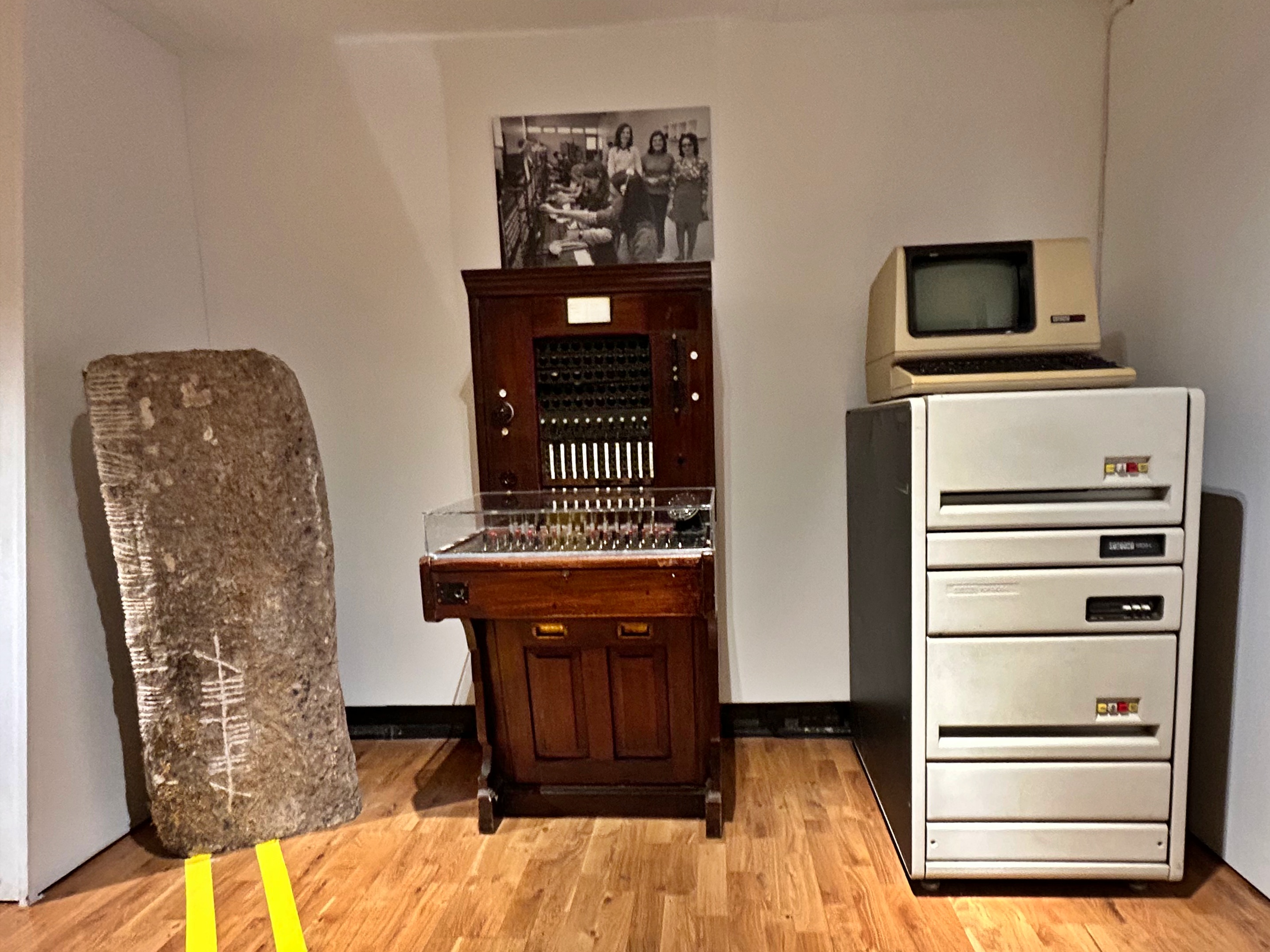
A plug-and-connect old telephone exchange, placed between an Ogham stone and a by-now ancient Digital VT100 computer terminal from the late 1970s, reflects how communications evolved over 1,600 years. A P⁊T phone box does something similar, though instead of a phone it has examples of postcards which were, in the pre-digital past, the way many of us personally communicated with family and friends.


There are bombs and guns and bullets and bayonets recalling Ireland's own wars against oppression and with ourselves and WW2, including a so-called 'non-lethal' baton round of the type used during the 'Troubles' in more recent decades.
 

There's poignancy in the clothes, playthings and home-school work of Dorothy May Petronell Grubb, who died at the age of 11 from typhus. Her things were stored in a box for 100 years before being given into the care of the museum.

There are exhibits of Tipperary-connected more gruesome past. Including a 1907 murder carried out in Monte Carlo by Clonmel-born Vere Goold and his wife Marie Girodin which involved hiding their victim's body parts in a trunk and suitcase. The former which leaked blood and a 'foul odour' and led to their capture. In that section there's also the disturbing and shameful account from the mid-1800s of the transportation of more than 4,000 Famine orphan girls as young as 14 to Australia to work as domestic servants, and to become wives in a place where there were many more men than women. Some 477 of those girls were from the Tipperary workhouses. While this is a generally little-recalled story in today's Ireland, these girls are commemorated every year in the Australian cities where they were sent.

On a lighter note, literally, Tipperary has a very strong musical history, especially from Clonmel itself. This is marked in the Museum of Hidden History by exhibits about famous in their day musical radio presenters Tommy O'Brien and Vincent Hanley, and stars from the town and wider region including Frank Patterson, Mick Delahunty, and the Clancy Brothers from nearby Carrick on Suir.

And still from hear-history, there are many of us who remember giving our own children toys like the Fisher-Price 'record player' that is among a small collection of what kids used to enjoy — before video, electronic, and digital innovation changed children's entertainment. Utterly. "D'you remember that?"
If you're in the area, do make a point of finding the Tipperary Museum of Hidden History. Small. Beautifully presented. An hour of putting our lives today into a little look-back perspective.
A full selection of the Diary's photos from the museum can be viewed here.

Photographs use Policy — Privacy Policy

Saturday, July 29, 2023

Out of Town: Lafcadio Hearn Japanese Gardens, Tramore


Less than an hour and a half's drive south of Kilcullen are some Japanese-themed gardens that look and feel as if they have been there for hundreds of years, writes Brian Byrne. But they were only opened in 2015.
The Lafcadio Hearn Japanese Gardens in Tramore, Co Waterford, were built to commemorate the life and works of Hearn, born on the island of Lefkada in 1850 to a Greek mother and Irish military father. He spent an extraordinary life across three continents, including childhood summers in Tramore. A journalist in America, and a translator of French classics, he eventually became a Japanese citizen and lived out his days in that country as a writer and university lecturer.
The idea for the gardens came in 2012 when Professor Bon Koizumi, great grandson of Hearn, came to Tramore with his wife Shoko to retrace the steps of his famous ancestor. A visit to the grounds of Tramore House led to the concept of developing a memorial garden there.
On our visit recently, there were performances as part of Tramore's inaugural Festival of Legend & Lore,  of music by the Duo Frizzante — Cathy Desmond on violin and Marian Ingoldsby on piano — with stories and poetry read by Keith Guinan and Stan Phillips. Clips from these accompany my images in the short Rough & Ready Production above.
The Lafcadio Hearn Japanese Gardens are a community-run not for profit social enterprise. They are well worth a visit.


Photographs use Policy — Privacy Policy

Saturday, July 08, 2023

Out of Town: Geology at Collins Barracks Museum


If you're looking to spend a couple of fascinating afternoon hours with the school-age children, a geology exhibition at the National Museum in Collins Barracks might be just the ticket, writes Brian Byrne.
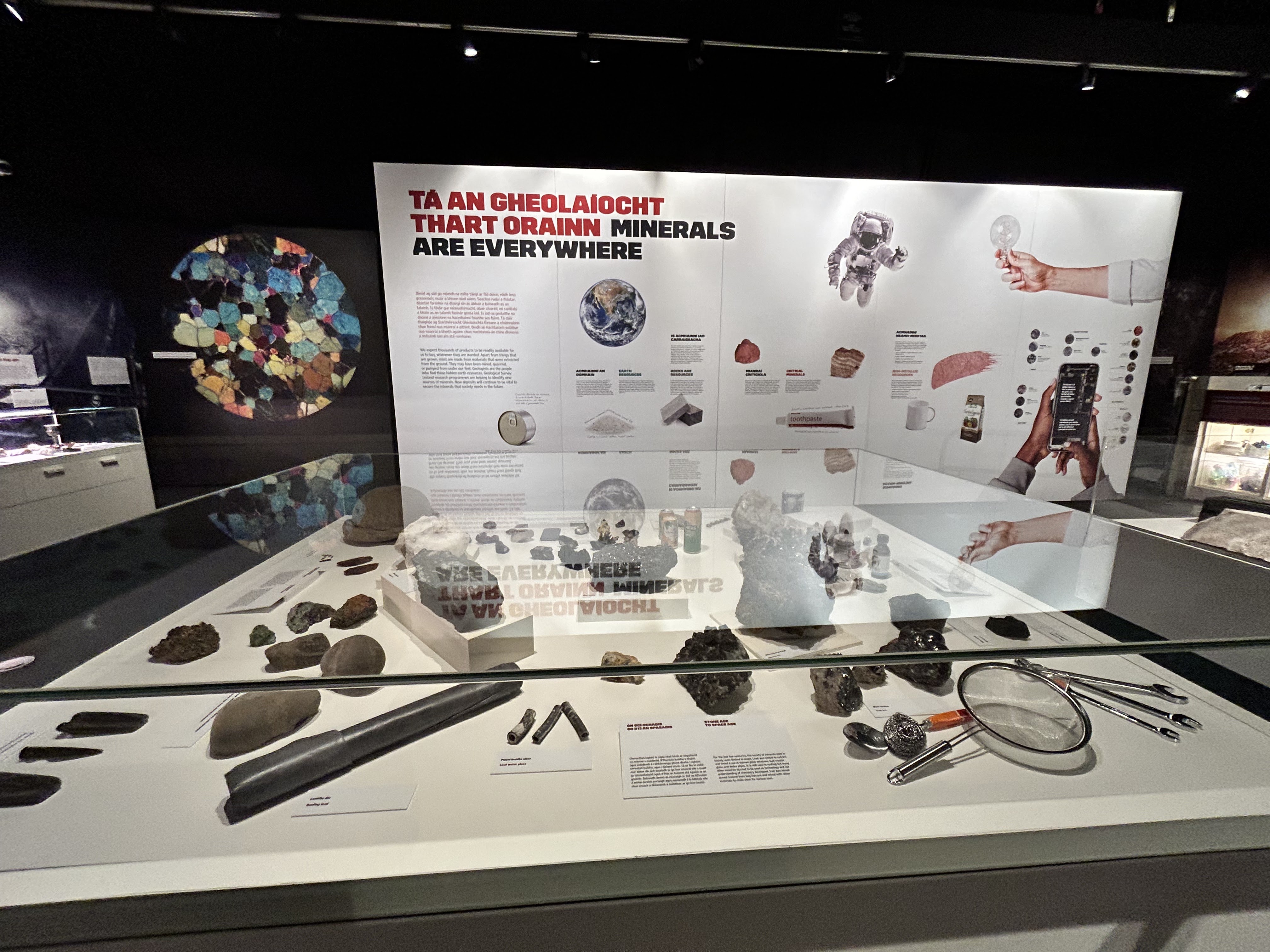
Down to Earth - Exploring Ireland's Geology is one of the most fascinating and very accessible hands-on ways of showing what's under our feet on this island of ours.
The exhibits include a large floor map of the geology of Ireland, a reconstruction of the research vessel RV Keary's wheelhouse, new art work depicting a cross-section of Dublin from Collins Barracks to the sea, and an impressive collection of the minerals we use in our daily lives. 
Developed in partnership with the Geological Survey of Ireland to celebrate that organisation's 175th anniversary, it has been in place since 2021 and is suitable for all ages and geological backgrounds.
Admission is free and the museum is only five minute's walk from Heuston Station.
There's lots more at Collins too, but best take it a space at a time.


Photographs use Policy — Privacy Policy

Friday, December 23, 2022

Snapshots in Berlin 2022

A short set of visual memories from a few days in Berlin in December 2022. They include strolling the Unter den Linden, taking in the Altes Museum, visiting Christmas Markets and Volkswagen's Game Changers exhibition on Friedrichstrasse, a cruise on the Spree, enjoying the 'Arise' show at the Palast theatre, and visiting the Futurium exhibition of tomorrow. 
A Rough & Ready Production by Brian Byrne for Kilcullen Diary.

Photographs use Policy — Privacy Policy

Monday, August 01, 2022

Out of Town: Kilmacurragh gardens and arboretum


The Diary took a trip over the mountains to the National Botanic Gardens site at Kilmacurragh House, Co Wicklow, yesterday, a hidden gem of 18th century garden and arboretum developed by the Acton family. Like many such big houses, they were hit with double death duties following WW1 when members of the family, and the staff of the demesne, lost their lives fighting in the trenches.
The Queen Anne style house is now roofless and derelict, but there is a commitment from Government to rehabilitate it under the direction of the OPW, which has managed Kilmacurragh for many years. The gardens have been restored by the National Botanic Gardens, and it's possible to enjoy the legacy of a family who took the long view in their travels around the world to bring exotic specimens of plant biodiversity back to their home.
There's also an excellent cafe operated by Brambles on site. A recommended trip, and you can get a 5-minutes photographic flavour of Kilmacurragh above.
Produced by Brian Byrne for Kilcullen Diary.

Photographs use Policy — Privacy Policy

Monday, August 03, 2020

Out of Town — Kilkenny Medieval Mile Museum

When you're used to going to a place from time to time, you can fail to notice when they add something new, writes Brian Byrne. That's what happened to me recently in relation to Kilkenny. They've added a Medieval Mile Museum which is now the go-to starting point for any new visitor to one of Ireland's most historic cities.

Set in the building and churchyard of the 13th century St Mary's Church, the Museum was a vision of the Heritage Council and the Kilkenny local authority in 2005 that became a reality just three years ago (but I never noticed in the several times I've been there since then). It's under the management of the Kilkenny Civic Trust, originally set up to manage the Butler House and Gardens and Kilkenny Design Centre properties in the old yard opposite the city's castle.

The museum is compact, but chock full of information and visual elements from as far back as Neolithic times, long before the original monastic settlement founded by St Canice. From then, it became a Norman stronghold following the arrival of Strongbow as an invited invader to Ireland.

The curator is Grace Fegan, who came to Kilkenny in 2001 to work as an archaeologist. By her own admission, she has been 'enthralled' by the city since then. Which is very evident when she enthusiastically takes the time to provide an arriving visitor with an introductory chat.

The city's story is fascinating, especially its growth as a fortified space where the wealthy who had been gifted land in the area could live in safety and comfort, and how those same families left important legacies to the city in business, ecclesiastical, architectural and archaeological areas.

The cruciform church itself is one of the best examples of its style and time. As a museum it uses both the original building's old graces and state of the art modern technology to enable visitors gain a solid foundation for further exploration of the city's 'Medieval Mile'.

It also houses Kilkenny's civic treasures, ranging from the Liber Primus Kilkenniensis of 1231 (above) to the charter bestowed on it in 1609 by King James I to the Mace and Sword that are the ceremonial symbols of power of the city. These are kept in a 'Kilkenny Room' built beyond the church chancel (below), on an area which would have been part of the chancel up to the mid-18th century and was demolished after Cromwell forced Protestantism to Ireland.

The foundations of an original tower which was on the site of the church have been uncovered, and are visible as you walk across glass panels on the floor. High above, the roof space has been partly opened up so that the very skilful carpentry work of the original builders is on view. The oak beams were hewn from trees which had grown in the region for more than two hundred years.

Exhibits include human remains found during five years of excavations, representations of the famous Ossary high crosses, and there's a chapel within the church dedicated to the Rothe business family which offers a range of ornate memorial tablets and other artifacts that help to bring history to life.


An interactive table touch-screen allows users to visually travel through Kilkenny's time and space and see where the old is only barely hidden behind the facades of today's city streets. Stories of artifacts and people can all be listened to on simple self-tour handsets provided to visitors, activated by pointing at relevant exhibits.

A visit can be as long or as short as one likes. Tickets are valid over a number of days, so if you're in Kilkenny for a couple or three days, you can keep coming back to remind yourself of detail or add more substance to what else has been seen in the Medieval Mile.

In the days of easy and affordable international travel, we may have forgotten how much there is to see and learn about ourselves in our own country. With the changed circumstances of 2020, places like the Museum of the Medieval Mile in Kilkenny can rectify that in a most enjoyable way.

I plan to return there, probably several times, over the coming months.


Photographs use Policy — Privacy Policy