Showing posts with label Kilcullen Architectural Heritage. Show all posts

Friday, June 20, 2025

ACA for Kilcullen will be Variation of County Development Plan


The preparation of an Architectural Conservation Area for Kilcullen will be progressed as a Variation of the Kildare County Development Plan 2023-2029, the recent meeting of the Kildare-Newbridge MD heard, writes Brian Byrne. The information was in an answer to a question by Cllr Tracey O’Dwyer.
But the project will have to wait until an Architectural Conservation Officer is recruited by the Council, officials told the meeting. Work is underway on this recruitment and also on the procurement of consultants for the provision of architectural services.
Cllr O’Dwyer’s query related to the recent adoption of the Kilcullen Settlement Plan, in which the ACA for the town is an objective, one which is supposed to be completed within 12 months of the plan’s adoption.
In relation to another query from Cllr O’Dwyer, on the process of identifying a bus turning location in Kilcullen, officials said the National Transport Authority has been asked to commence discussions with the council’s Planning and Transport departments.

Photographs use Policy — Privacy Policy

Friday, June 13, 2025

Council asked to commence architectural conservation process for Kilcullen

Kilcullen c. 1900. Image: The Lawrence Collection.

Kildare County Council is being asked to confirm if it has commenced the process of designating an Architectural Conservation Area to protect the historic urban core of Kilcullen, writes Brian Byrne. The query comes by way of a question from Cllr Tracey O'Dwyer for an answer at the upcoming meeting of the Kildare-Newbridge Municipal District. Such an ACA would enable conservation of buildings of significance and resist any attempts for their demolition.
The ACA is an objective of the recently adopted Kilcullen Settlement Plan, and is required to be commenced with 12 months of the plan's adoption.
In the Kilcullen Design Statement published in 2023, the consultants who produced it under commission from Kilcullen Community Action said the Main Street should be designated an Architectural Conservation Area, so as to facilitate conservation and restoration with the help of appropriate architectural guidance. The document also recommended that a record of Kilcullen's heritage assets should be compiled as a first step in preserving and enhancing the town's historic character.

Photographs use Policy — Privacy Policy

Saturday, May 31, 2025

Liffey View House demolished


Liffey View House on Kilcullen's lower Main Street has been demolished this morning, writes Brian Byrne.
According to the National Inventory of Architectural Heritage, the building dates from between 1700 and 1837. It has been derelict for many years.
The combined properties of Liffeybank House and Liffey View House were originally acquired by Sir Anthony O'Reilly of Castlemartin in 2007, when planning permission was sought by Arquette Limited for a mixed restaurant, cafe, retail and commercial, and apartments complex. Both were noted to be Protected Structures. Permission was granted in April 2008, but the development was not able to go ahead, because of Kildare County Council's failure to upgrade the Osberstown Sewerage Treatment plant, a condition in the permission. An extension of planning permission duration was granted to Arquette in 2013.
In March 2018, an application for an extension of duration of planning permission had been lodged by Mark Dyer and Drinda Jones. That application was refused by Kildare County Council on 2 May 2018. In October 2018, the combined property of Liffey View House and Liffey Bank House in Kilcullen was put up for sale as a development opportunity.
A barn on the property known as Brennan's Loft, the original home of boxing in Kilcullen, was demolished in 2006. 

Photographs use Policy — Privacy Policy

Monday, December 21, 2020

Kilcullen 'Arch and Ornaments', a small mystery?


This is an interesting antique architectural print of church arches, the one of local interest merely titled from 'Arch and Ornaments at Kilcullen, Co Kildare', writes Brian Byrne.

The lower half of the page is a representation of arch and ornaments at Disert, Co Clare.

The page is on sale at Antico on line for £20. Though undated, it was published in 1797, printed by M Hooper in London.

I thought at first it might have been from St Patrick's Church of Ireland at Carnalway, but it doesn't appear to be.

The other thought was St John's at Yellow Bog, but that was built in 1815, so the print predates it by a significant period of time.

As St John's is thought to have been built to replace the one beside the round tower at Old Kilcullen, maybe it had such ornamentation before it was abandoned?

Any ideas, anyone?

Photographs use Policy — Privacy Policy

Saturday, August 01, 2020

Two Kilcullen properties proposed for protection status

Pics from consultation documents.
Two properties in Kilcullen are included in a public consultation from Kildare County Council on adding to the Record of Protected Structures (RPS), included in the County Development Plan 2017-2023, writes Brian Byrne.

They are New Abbey House, Gate Lodge and Demesne; and The Hermitage thatched cottage at Carnalway, described as a 'gentleman's residence' from around 1800 in The Thatched Houses of County Kildare by Charles Duggan.

New Abbey House dates from the 1750s, with later additions including a stable block and courtyards from the 1860s.

Extensive details of both properties are available here and here and can be inspected until 20 August.

Submissions or observations in respect of these proposed additions can be made in writing to: Veronica Cooke, Administrative Officer, Planning Department, Kildare County Council, Áras Chill Dara, Devoy Park, Naas, Co Kildare or online. The closing date for receipt of submissions is 5pm, 24 August 2020.

Photographs use Policy — Privacy Policy

Monday, June 15, 2020

Return of the pump

After three years' absence, the old pump which has been a Kilcullen streetscape landmark for a century, maybe more, has been returned to its space near The Hideout, writes Brian Byrne.

The fixture was knocked down by a delivery truck in 2017, and has been held in storage by Kildare County Council ever since.

Despite many efforts to have it reinstated, particularly by Kilcullen Community Action, and with the broken base a clear and present danger to pedestrians, the pump languished in the darkness of some shed or other.

Earlier this year, KCA enlisted the support of County Kildare's Heritage Department in trying to have it restored. The coronavirus restrictions then arrived, and it seemed to have been forgotten again.

But this morning it was quietly replaced, the broken base fixed. The strange thing is, many people walked by and drove past not realising the cone and sandbags which had been covering the broken base were gone, and the green pump was in its rightful place.

This evening, KCA's Ray Kelly came down to see for himself, delighted. "The only thing missing now is a pint from the Hideout to celebrate," he said.

The pump still bears the scratches from its impact with the truck, and the burn marks where it was welded. But a coat of paint will fix that. And there are already plans being made to make it a floral element of Kilcullen In Bloom.

Just a point, it is purely decorative. The pump has not been operable for decades. But when it was a still regularly used source of well-water, Kildare County Council would lag it with straw every winter to stop it freezing, an overcoat which was from time to time set on fire by persons unknown, late at night.

Photographs use Policy — Privacy Policy

Saturday, February 02, 2019

Work on building with long heritage

A good early spring sign this morning, to see serious work being prepared for on this building which was in danger of falling down, writes Brian Byrne.

The building is listed on the National Inventory of Architectural Heritage, from a survey carried out in 2000, when it still bore the name of the Moloney family. It is described there as an 'End-of-terrace three-bay two-storey house, c.1840, possibly originally two separate houses ... renovated, c.1900, with timber shopfront inserted to left ground floor ... a fine and substantial building that, although in fair condition, retains an early aspect and character'.

The appraisal notes that the shopfront emphasises 'the social and historic importance of the building as early evidence of the commercialisation of Kilcullen in the mid nineteenth century'.

At the end of the 19th century, when the building was photographed by Robert French for what became one of the Lawrence Collection of photos, it was owned by a Margaret Egan, a Grocer and Spirit Dealer. In September of 1881, Miss Egan's election as an 'associate druggist' was recorded in the Chemist and Druggist magazine.

Miss Egan remained the owner of the business through the turn of the century, and in 1901 at the age of 50 was listed in the house as a shopkeeper, along with her older brother George, listed as an optician. Also listed was a Richard Egan, a currier, aged 35 and who had been born in Co Cork, possibly a relation come to live with them?

By 1911, no Egans appeared in the town census. But Miss Egan was the vendor of the leasehold to Patrick A Moloney in 1918.

Photographs use Policy — Privacy Policy

Sunday, August 26, 2018

Kilcullen's architectural heritage revisited - Part 1

Fifteen years can be a long time these days in the streetscape of a one-street town like Kilcullen, writes Brian Byrne. What would in earlier times have taken maybe dozens of years for change can now happen in a much shorter period of time.

Around 2000, as part of a National Inventory of Architectural Heritage, 36 properties and structures in Kilcullen were listed in a Building Survey by the NIAH, which is a service of the Department of Arts, Heritage and the Gaeltacht.

The Kilcullen list was published in 2003, and since then some of the properties have changed, in small and larger ways depending on their position, use and ownership.

Bardons (top) is one which stands out, built around 1800 and described in 2003 as 'a fine and imposing pair of houses' with a 'dramatic impact' on the streetscape. The appraisal notes the renovations and remodelling over the years — key dates were 1900 and 1980 — which reflected the evolution of the houses, including use as a hotel. The 'canted entrance bay' distinguishes the structure. Since the 2003 picture, another 'evolution of use' is the insertion of the takeaway food business into what was a dining room during the building's hotel days up to the early 1950s.

Across the road is the Credit Union building, the original part of it dating back to around 1840 according to the NIAH, which describes it as an 'attractive middle-sized building' which has retained 'some of its early character. In this writer's memory it was a teachers' residence in what had even then the remains of a shop frontage, possibly a pub at one stage. Since the survey, the building has been cleverly incorporated into the modern credit union facility, and from the original photo's perspective, a cleaner frontage arguably shows off the original much better than in 2003.

Just up the street from there is the three-storey building that is today used as part of a Medical Centre. In 2003 it was a secondhand clothing store, but in the revision which externally concentrated on the ground floor, today's version is a definite improvement. The NIAH set the date of the building at c1830, with 'graceful proportions' and important for continuing the 'established streetline and roofline' of the streetscape. The appraisal notes it was built as a pair with the house directly down from it.

We'll continue with this series of comparisons over coming weeks. Any feedback and comment would be welcome. The smaller photographs are from the National Inventory of Architectural Heritage.

Kilcullen Diary Policy on Photographs. Kilcullen Diary Privacy Policy.

Saturday, August 04, 2018

Kilcullen's architectural heritage

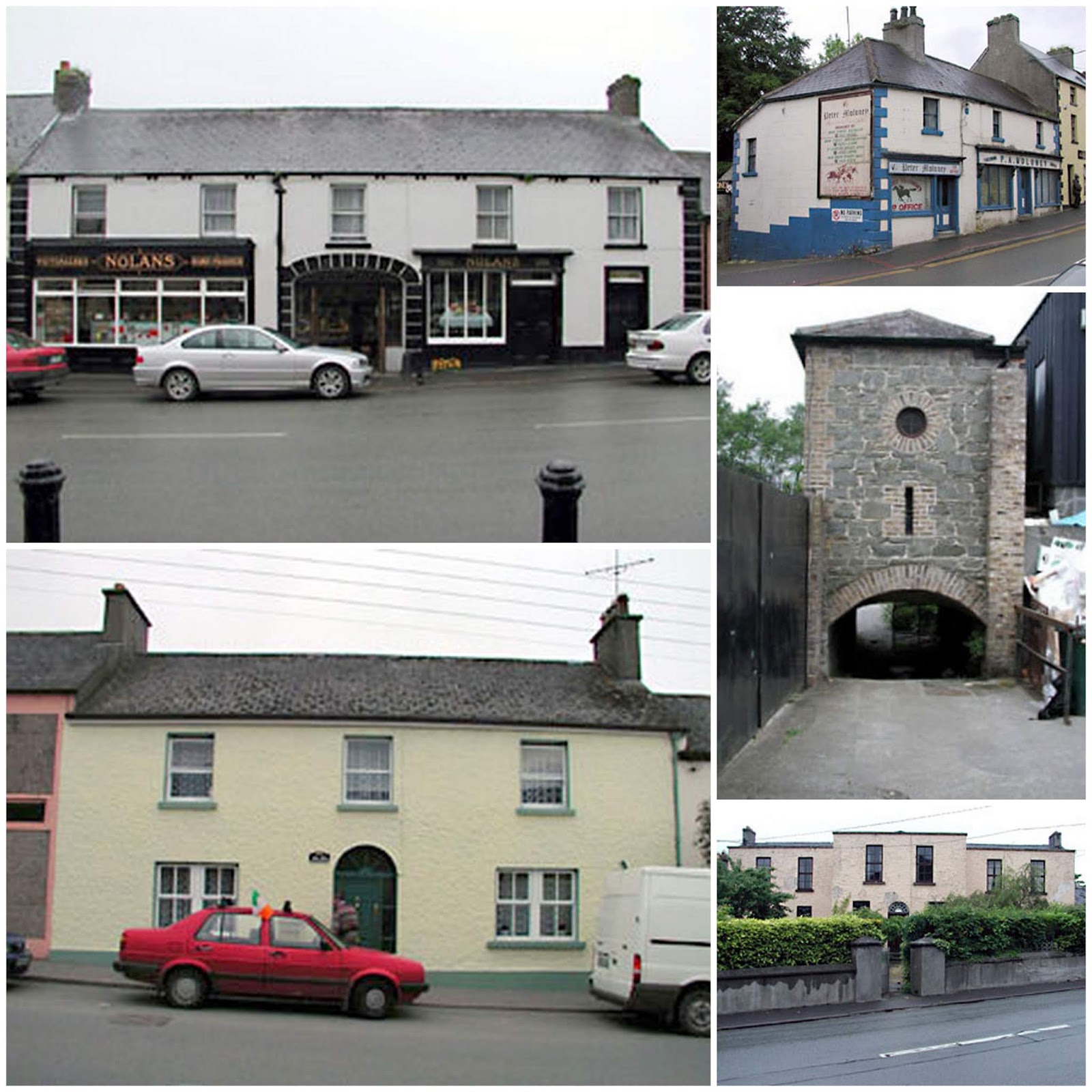
Clockwise from top left: Nolans, Moloneys, corn mill, Liffeybank, and the Old Courthouse. Pics from NIAH.
There are 36 properties or structures in Kilcullen which are listed in the National Inventory of Architectural Heritage, writes Brian Byrne.

The survey was carried out in the period around 2000, and includes residences, shops, pubs, the bridge, gateways, churches, schools, street furniture, New Abbey graveyard, and a post-box.

Looking back at usage, ownership and state of repair in 2003 makes interesting comparisons over the intervening 18 years. Some remain as were, others have changed hands or tenants, some properties which were derelict have been restored, and a number have become derelict.

There are some interesting omissions, notably to this writer's mind being the Hideout as a crossroads prime building since 1855, and the former Hibernian Bank opposite the market square. It could be argued that the Garda Station should also be included as a very good example of its kind.

The Building Survey is the core work of the NIAH, which is a service provided by the Department of Arts, Heritage and the Gaeltacht and was established in 1999. The survey is ongoing and its purpose is to highlight a representative sample of the architectural heritage of each county and to raise awareness of the wealth of architectural heritage in Ireland. The NIAH has also carried out surveys of gardens in Ireland.

The majority of buildings included in the Building Survey are privately owned and are not open to the public.

In addition to recording and evaluating the country's post-1700 architectural heritage, the surveys are used as the basis for recommendations to planning authorities from the Minister for Culture, Heritage and the Gaeltacht.

Over the next while, the Diary will rephotograph the Kilcullen inventory to highlight some of the changes.


Kilcullen Diary Policy on Photographs. Kilcullen Diary Privacy Policy.

Saturday, July 21, 2018

Refurbishment of Garda Station an asset to the streetscape

It has to be said that Kilcullen's Garda Station is now looking really well, following an extensive external refurbishment and repainting, writes Brian Byrne.

It had become somewhat unloved in appearance, but now is a quite beautiful element of the town's streetscape.

The works were carried out as part of the Garda Station Building and Refurbishment Programme 2016-2021.

Kilcullen Garda Station is a fine representative of a series of rural stations built by the Free State government in the 1920s and 1930s. The style is attributed to T F Rippingham, who worked as an architect with the Ministry of Finance, Northern Ireland and the Office of Works in London, prior to the Treaty that established the Irish Free State in 1922.

Kilcullen Diary Policy on Photographs. Kilcullen Diary Privacy Policy.