Showing posts with label technology. Show all posts

Tuesday, September 01, 2026

INNOVATION EVENT FOR LOCAL TECH IDEAS


An Idea Ignition event on September 24 at the MERITS Innovation Thinkspace, Naas, will showcase early-stage tech ideas and prototypes from the region’s brightest minds, writes Brian Byrne. The free event will run from 6pm to 8pm.
Hosted by Local Enterprise Office Kildare, there will be live demos, networking opportunities with founders and funders, and creative discussions. Bring your tablet/laptop, pitch-deck, and promotional materials. 
Whether you’re a tech enthusiast or investor, this is a chance to gain insights and share knowledge with the MERITS community in a celebration of innovation!

Photographs use Policy — Privacy Policy

Friday, July 19, 2024

A nun, a magnet, energising a career in technology


When Cross and Passion nun Sr Brendan demonstrated to Senior Infants the properties of magnets and how they can move metal around, she contributed to exciting one Kilcullen pupil into a fascination about science, writes Brian Byrne. That young boy was Eugene Brennan of Nicholastown, who later became an electronics engineer, and today is passing on his own passion for science and technology through his blogs and Facebook pages.
“My father and grandfather were also technical people,” Eugene recalls. “My father worked as a fitter on the Curragh, and when I was very young he used to bring home scrap motors and other assorted electrical items like coils and buzzers from old equipment, and I tinkered with those.”
After the Senior Infants magnets session, Eugene came across a Ladybird book on the subject in the school library — Magnets, Bulbs and Batteries — and when he mentioned it at home his family sourced a copy for him. “It’s still my favourite science book,” he says, adding that in his own articles on his blogs and produced for other internet sites he works on the Ladybird principle of making highly technical stuff understandable to the ordinary reader. 
Eugene is the youngest of his family, with older siblings who worked in teaching, nursing and childcare, and for a state body. He had a childhood aspiration to go to Australia, by digging his way there after reading yet another Ladybird book, on Mining. "That didn't work out," he laughs. "But I still like digging holes in the garden." There was also a Chemistry Set in his growing up years, "with stuff like toxic and explosive chemicals that you'd never get in sets today." In the Patrician Brothers in Newbridge he did Science for his Inter Cert and Physics and Chemistry for his Leaving.
After studying Engineering in DIT Kevin Street in the mid-1980s, Eugene qualified with a degree in Electrical, Electronic Control and Instrumentation from TCD. He also has a FETAC qualification in Industrial Automation from FÁS Cabra. He subsequently worked on a number of projects with different employers, among these helping to develop a device used on earth-moving machinery for levelling ground. Another was development of data logging and telemetry software and equipment, used by local authorities in monitoring sewage and water treatment plants. "I also worked as a calibration technician for Weber Sensors Ltd in Naas."
Eugene's work often involved writing instruction manuals for technicians, with graphics and tables showing how to operate equipment. "I enjoyed doing that," he says, recalling how, even earlier, his first production of an infographic was in Gerry O'Donoghue's class in primary school when he made a mixing chart for paint colours, subsequently used by fellow pupils. Around two decades ago, following a period of unemployment, he began writing in earnest and particularly creating mathematics and physics tutorials on a number of websites, and also writing tool guides and about gardening and DIY.
He has three discussion groups running on Facebook. Kilcullen Gardening, Talking Tools, and most recently Kilcullen Science & Engineering. The titles are self-explanatory, the concept being platforms for people to talk about the subjects, and also to help novices in the various fields. "They are mixtures of short, original articles written by myself, and also links to other articles I've written and a variety of curated content from reputable sites. I also share links to recommended podcasts I've listened to."
For example, on the Kilcullen Science & Engineering Facebook page, recent short pieces include an explanation of why some ominous clouds in thunderstorms look like they do — it's to do with hail in suspension. There's an introduction to a podcast about editing DNA, musing about paranormal experiences in old buildings, and a link to how a heart works. Go to his blog of the same name and you have easily-understood pieces on a myriad of STEM subjects, from astronomy through electrical engineering, geology, mathematics to psychology and everything in between. 
From hubpages.com (eugbug) you can browse a wildly eclectic range of How To articles which he has written on a range of websites, from How to Fix a Button on Jeans Without Sewing to Understanding the Principle of Archimedes — both pieces of essential life knowledge — to Top 100 Cool Science Facts for Kids. "In total, I'm up to 13 million reads of my articles now on all those other websites. Some get more traffic than others, and they're seasonal — in the summer the gardening gets more interest, for instance, in the winter when kids are back to school, the others do better." The Kilcullen-specific pages don't particularly register highly, but that's a matter of Google's indexing policies. 
Eugene Brennan's mind is clearly a complex rabbit burrow network of polymath knowledge, from which he has been essentially "paying my bills for five or six years" through advertising revenue around the articles he has written. He first got involved in this process about a dozen years ago, initially not realising that it could be monetised. "It started off with one article, and then I improved on the system," he recalls, agreeing that he effectively 'fell into' internet income generation. "I started including photographs, and structured the articles better. I like explaining things."
Eugene has concerns about the future of writers like himself in the era of AI, where a search on the internet won't bring a page of links but will be capable of writing an article on the requested subject 'on the fly' from all the information already out there. There are also ongoing issues with people copy-paste stealing of his material. "I waste quite a bit of my time serving takedown notices to Google and hunting down the people who steal articles, and then I have to go to the hosting companies to notify them of copyright infringements."
But for now, it's quite probable that, somewhere out there, there are young people who are becoming energised about science and technology through a chance encounter with one of Eugene's pieces. If so, it's a nice example of life's circularity.


Photographs use Policy — Privacy Policy

Tuesday, October 05, 2021

Info afternoon on electric cars


For anyone interested in the pros and cons of electric cars, there will be a meet-up of EV owners at the Circle K Service Area at Halverstown on Saturday 16 October, writes Brian Byrne.

The event will begin at 1pm, and there will be new and experienced EV owners on hand to answer questions and describe their own experiences.

All welcome.

Photographs use Policy — Privacy Policy

Thursday, September 09, 2021

Is the EV charge point the new small pub?


As today is International EV (electric vehicle) Day,
writes Brian Byrne, I'm reproducing this article I have in the current issue of The Bridge.)

Every time I take an electric car for review, I learn something more about electric motoring. No, not necessarily from the car, but from the people I meet at charging points.

It's kind of like a pub that deals a lot with passing trade. Short enough visits, but time enough to say hello to strangers, and strike up short but pleasant relationships.

There's still a community spirit around electric cars, even now when there are so many more of them about. More models, more brands, more range diversity. But it's also because there are more EVs about that you get the chance to meet such people, because there can be a bit of a wait to hook up if there are more cars than plug-in facilities.

In fairness, I haven't had to wait often, and then only ten or 15 minutes. And because it's still a relatively new 'club', there's invariably a level of courtesy and friendliness somewhat above what you expect at the fill, pay and go petrol pumps. Indeed, maybe because EV owners are used to taking that extra time to 'fill up', they seem to be a much more relaxed bunch.

Personalities can often relate to the age of the cars they're driving. Like the woman with the 2016 secondhand Nissan Leaf who commutes from Dublin to Kilkenny, and the range of her car just about allows that. But sometimes she has to go to Waterford, and I met her at my local Circle K, having a sandwich and crisps lunch while she gave her car a boost. She had a book on her lap. "I get to read a lot," she said, adding that even with the limited range for her relatively long drives, she wouldn't go back to an ICE car. "It's saving me a lot of money."

There was another woman with a Peugeot e-208 she has had for the last six months. From just outside Limerick, she was figuring out the system at the new charge points at Junction 14 near Monasterevin. "I haven't used one before," she said as she peered at the screen, ESB card in hand. She charges at home all the time, and the car has been working perfectly for her local driving with just plugging it in twice a week. She was stopped at Junction 14 while on the way to meet her daughter at the Kildare Village, because she wanted enough charge to go straight home again afterwards. I said it was delaying her from her meeting. "No, it's saving me money. As soon as we meet up the spending will start."

As I was topping up a Renault Kangoo ZE van last week, a Tesla pulled in beside me, parents and a pair of children on board. Clearly well used to it, they hooked up and sat, relaxed, as their car was charging. I disconnected and pulled out. As I drove around the circle to leave the woman from the Tesla got out and waved me down. "You forgot to close your flap," she said with a friendly smile (the charging cover on the front of the car). "Will I close it for you?" Courtesy to a van driver, from the driver of an expensive Tesla. You don't get that at the petrol or diesel pumps.

Those I've mentioned have all been women, but the reactions are equally laid back from the men I've got talking to. And there have been hardly any negative vibes about their electric choice. The main concern is that, now that there are more of their kind, the public charging points are showing the strain. The infrastructure IS improving all the time, but will need to be ramped up further if serious queuing is to be avoided. It would be a shame if all this well of patience and bonhomie I've been experiencing was to be lost.

It's doing us all good. Like when, before motorways, there was always a small pub on the journey at which to take a break. The charge point area is the small pub, while the petrol forecourt is a big frantic Weatherspoons.

Photographs use Policy — Privacy Policy

Wednesday, June 17, 2020

Survey on over-55s access to technology

The Kildare Public Participation Network is conducting an online survey on access to technology in the county for over-55s, writes Brian Byrne.

The purpose of the survey is to see if older adults are suffering in a particular way because of lack of access to technology, and to identify if there is a need, or how much of a need to develop a strategy around this.

The partners involved are Older Voices Kildare, Muintir Na Tire, Kildare PPN, County Kildare Leader Partnership and the Age Friendly Programme.

The questions on the initiative are related to location, age group, whether the respondent uses digital technology and in what form.

There's also a query as to what supports the respondent would like to have in order to be able to use such technology.

(There doesn't seem to be an option to conduct the survey by old-fashioned paper and post, but presumably a tech-savvy relative or friend could do it on behalf of someone who doesn't already have online access.)

The survey can be accessed here.

Photographs use Policy — Privacy Policy

Saturday, February 03, 2018

The Diary's electric road trip

If you noticed your editor wasn't much visible in Kilcullen during the week, it was because I was on a very interesting road trip, writes Brian Byrne.

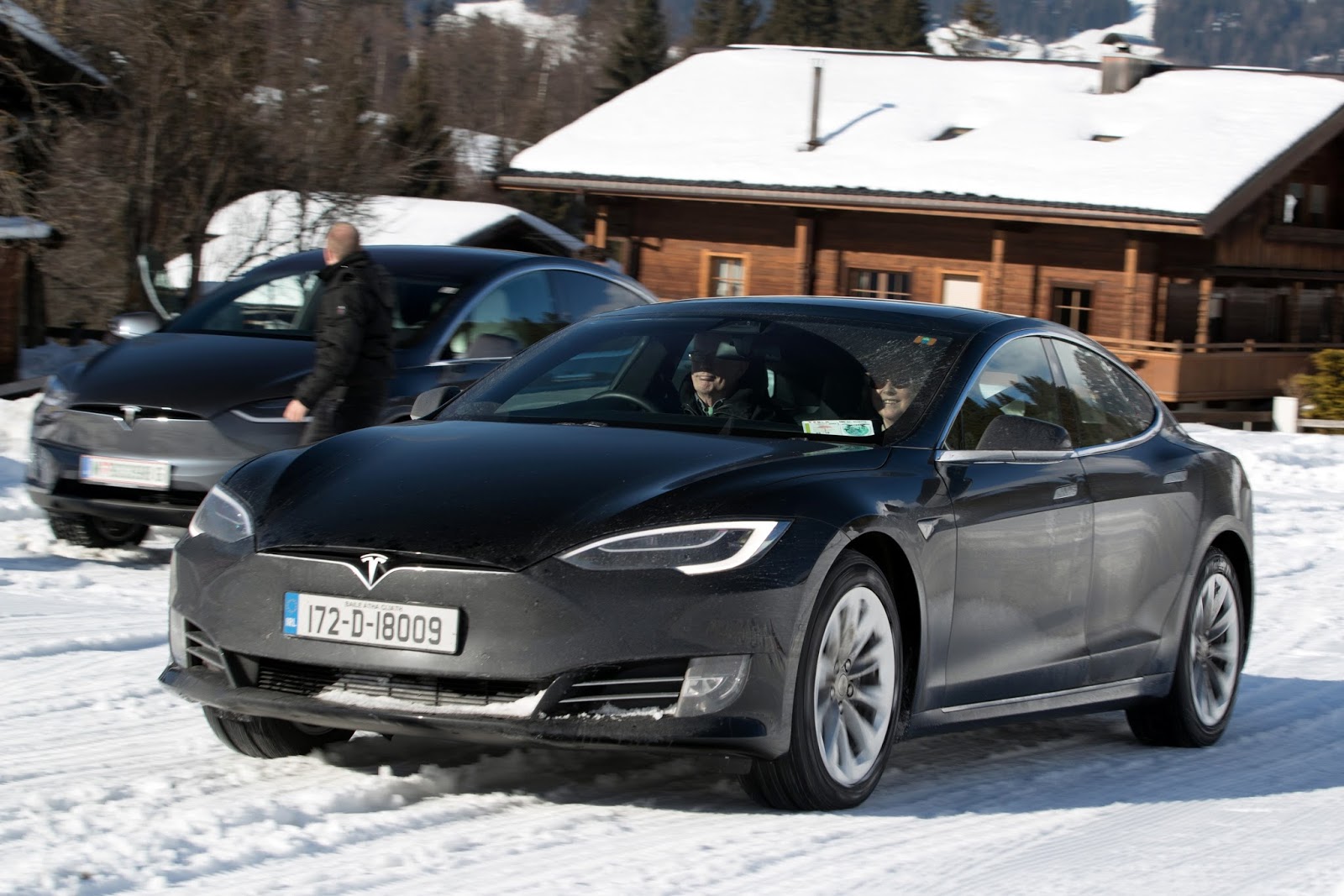
The Tesla Motors company had invited myself and fellow motoring journalist Trish Whelan to Alpbach in Austria to experience driving their Models S and X in snow, to show off the AWD capability of their cars.

And then to drive a Model S all the way back to Dublin, to show that an electric car can do the long distance travel thing just as easily as a standard car with a petrol or diesel engine.

It can. Leaving Alpbach late on Tuesday afternoon, we arrived back in Dublin at lunchtime on Friday, a total distance of more than 1,900km of which 1,750km was actual driving.

Under the sea on the Eurotunnel.
The rest was crossing the English Channel by EuroTunnel, and the Irish Sea courtesy of Stena Line.

Charging during lunch stop at Nancy, France.
On the trip we recharged from Tesla supercharger stations at Nancy and Reims in France, and Warwick in England. The car was also charged during hotel overnights in Zurich, Calais, and Holyhead (that last in the very unusual Chateau Rhianfa on Anglesey).

Overnight charging at the Chateau Rhianfa on Anglesey.


It was long driving each day, far more than anyone on holidays would sensibly do, and in a variety of conditions which included torrential rain. But it showed very much to me that electricity can be just as convenient a power source for a car as any other 'fuel'.

Heading for the Vosges area of France.
Oldest and newest on the historic road from London to Holyhead.
Both of us will be writing in detail of the experience in our respective motoring outlets, including our own 'Irish Car+Travel' magazine (the current Car Guide 2018 issue is in the shops at the moment).

But given the number of electric cars already in Kilcullen, as evidenced in a recent 'Bridge Magazine' article, I thought the Diary's readers might be interested.

Saturday, April 18, 2015

Screen-free week

It had to happen — there's now an International Screen-Free Week (well, actually it has been around since 1994) for those who want to swap the digital life for something other than pixels.

This year it takes place between 4-10 May, and while it doesn't make any sense for the Diary to be promoting it, the period is an opportunity for children (and their parents) to lift their heads and smell the roses. Maybe even talk instead of texting?

Anyone who wants further information can check it out on screen-free.org. Note that the initiative is presented by the Campaign for a Commercial-Free Childhood, and it's all American.

Meanwhile, closer to home, a survey is being undertaken by Early Childhood Ireland on how children are using technology in their homes, places of care, and education.

ECI is especially interested in the views of parents of young children, and is inviting the completion of a short survey here.

Tuesday, April 16, 2013

Ideation team in final at weekend

ideation30

The Cross & Passion College 'Ideation' team which won through to the final of the Intel-sponsored young entrepreneurs competition will be going head to head with teams from 13 other schools next Saturday, writes Brian Byrne. And the winners get to go to Silicon Valley for a week.

An idea for an iPhone case that doubles as a diabetes monitor secured a place in the finals for Aaron McLoughlin-Sutherland, Godwin Jalanga, Bevan Murray, Robyn Kenny, Caoimhe O'Fearghaill, and Wayne Donohoe.

The team won out against other TY teams from the school at the end of the first Intel Ideation Workshop in CPC in February, organised by Kilcullen Lions Club.

The team's concept includes an app which will give instant blood sugar reading from a blood test strip inserted into a computerised reader that's part of the case. If blood sugar is low, the app will tell the owner to take some sugar gel that's part of the kit, and if it is critical a phone message with GPS location and details will be automatically sent to the owner's doctor and parents.

It's the first year the Intel Ideation workshops have been run in Ireland. Some 1,500 students have taken part, from schools as far apart as Skibereen, Kinsale, Tullamore and Carrickmacross. The final is at the Intel plant in Leixlip.

Thursday, March 07, 2013

Deputy picking up broadband problem

Any individual or company in Kildare South who doesn't have access to high-speed broadband is asked to contact local FG TD Martin Heydon, who is collecting data on the problem for presentation to the Minister for Communications.

The deputy was prompted to make the call with this week's commitment that 216 schools in Kildare, Dublin and Meath will have full broadband by September of this year.

Deputy Heydon wants Minister Pat Rabbitte to review the provision and quality of broadband in many rural parts of Kildare.

“I welcome the proposed roll out of high speed broadband (100mps) to all secondary schools in Kildare by September 2013," he says, "but unless something is done to address the serious lack of broadband services in many rural areas of Kildare, these pupils will have no access to broadband when they go home in the evenings.”

Many rural areas in South Kildare lack broadband services sufficient for basic internet access. Calverstown, Narraghmore, Suncroft and Castledermot are examples. Many living in these areas are trying to run small businesses or work from home without broadband it is just not possible.

Those who currently can't get broadband are asked to contact Deputy Heydon's office on 045-487624.

(See the Diary's earlier stories on the broadband issue.)

Thursday, February 21, 2013

Better internet on the way

Kilcullen is to get fibre-optic broadband by 2015, significantly improving internet service in the area.

This will happen with the upgrading of seven of Eircom's hubs in County Kildare. Along with the Kilcullen hub upgrade, improvements are being made in the Curragh Camp, Kill, Monasterevin, Prosperous, Robertstown and
Rathangan.

It all, the current plan is to upgrade 78 hubs nationally to fibre-optic by 2015.