Showing posts sorted by relevance for query Thornton Lace. Sort by date Show all posts

Tuesday, August 19, 2025

Thornton Lace talk on grassroots ingenuity and compassion

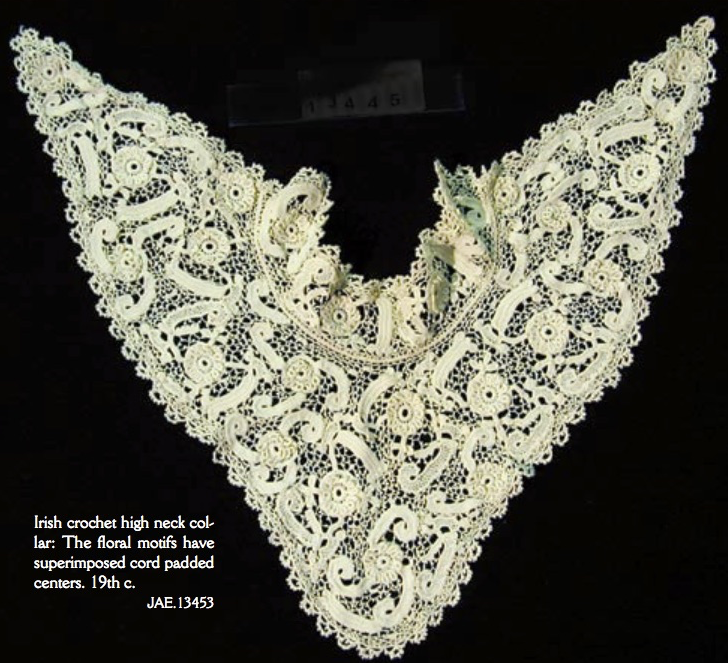
Irish crochet lace collar, maker unknown, circa 1850, in the Victoria and Albert Museum.

The inspiring story of Thornton Crochet Lace is the focus of a National Heritage Week event at Kilcullen Library on Wednesday evening, writes Brian Byrne. It's a remarkable example of grassroots ingenuity and compassion during a time of great hardship. 
The evening is hosted by Mary Barber, who will share how Mrs Roberts, the wife of a local clergyman in the townland of Thornton near Grangebeg, taught impoverished women to make lace around the 1840s to help ease the suffering caused by the Great Famine. This effort quickly evolved into what we might now call a cooperative, where lace-making — then extremely fashionable across Europe — provided a vital income for many households in the Kilcullen area. 
"I grew up about a mile from Thornton but had never heard about the lace," Mary Barber says. "As an adult, I crocheted as a hobby, but was unaware that crocheting lace played a significant role in famine relief. What struck me most in the story of Thornton Crochet Lace is that it wasn't a government scheme, an expertly orchestrated endeavour, nor did it build on any pre-existing foundation. It was a new endeavour born from the best of human kindness." She describes it as a 'real miracle of the loaves and fishes.' "In terms of people's abilities, Mrs Roberts brought what she had to help suffering women, who used their skills and created a product worth more than its weight in gold." 
She says she first read about Thornton Lace in the Kilcullen Diary, referencing a history written by Chris Lawlor. As Mrs Roberts wrote herself, "I then taught five poor women to copy the crochet spiders, and then lent them different pieces of old lace, and of their own ingenuity they brought it to its present perfection." 
An important part of the story is that each person taught to make the lace had to pass the skill on to three others. Soon, up to 100 women in the Kilcullen area were earning money, and others were bringing the skills to other parts of the country. 
On the night, Mary will discuss the history of the famine in this region, explore the general significance of lace, and tell the story of Thornton Crochet Lace. There will also be an opportunity for attendees to try crocheting afterwards. 
"I'm hoping Kathie Earle will attend. She is an expert at crocheting lace and an avid enthusiast of Thornton lace specifically. She turns the academic into an actual creation." 
The event starts at 7pm, is free, and will include a chat and refreshments afterwards.


Photographs use Policy — Privacy Policy

Friday, November 27, 2015

Kilcullen once centre of lace


Though there's no remains of it in the town today, Kilcullen apparently was once a major centre of the crochet lace industry in Ireland, writes Brian Byrne.

The craft is reported to have supported up to 700 women workers around Kilcullen in the middle of the 19th century, and is credited with bringing the industry to Clones in Co Monaghan, founding a tradition in that area which continues to this day.

The story of the Kilcullen industry starts with the wife of a local Rector, Mrs Martha Roberts, who began teaching the craft around the mid 1840s to women, to try and alleviate the hardships of the Great Famine.

There had been a tradition of knitting in the area, but there was no longer a demand for it, so Mrs Roberts, according to a letter from her in existence, showed five women how to crochet from a piece which she'd had sent to her from a sister in England.

This was done at a school set up at the Roberts' home in the townland of Thornton, between Kilcullen and Dunlavin, and the deal was that once her initial group had mastered the technique, each had to train three more women in the craft.

The beauty of crochet was that no equipment was needed except thread and a hook that could be home-made. There was also a demand for the kind of relatively cheap lace due to the growth of the middle classes in Europe. For a decade or so, the local business flourished, spreading the brand of Thornton Lace widely as a style in its own right that became highly prized.

According to Chris Lawlor's 'Little Book of Kildare', the industry was so successful that it generated payments of between £100-£300 a month, with the bulk of the workforce coming from the area around Kilcullen.

But the Thornton school was a victim of its own success in a number of ways. The ethos of the school's workers to train others actually resulted in the setting up of competing operations in the different parts of the country. Chris Lawlor feels that the demise of the Thornton business was 'inextricably linked' with the rise of Clones lace, started by workers from Thornton sent there by Mrs Roberts at the request of Mrs Cassandra Hand, wife of local Rector Rev Thomas Hand. Mrs Hand wanted to emulate the Thornton industry for similar Famine relief reasons in her own locality.

According to a history of Irish crochet on 'Irish Crochet Together', they were among 28 Thornton women sent on request by other ministers' wives to various parts of the country

There is also some suggestion that eventually the quality of the Thornton product deteriorated while that in Clones became much better. Also, the Kilcullen designs apparently couldn't be changed quickly enough for buyer fashion changes. There was also the development of cheaper machine-made embroidery and lace, with consequent uncertainties for the hand-made product.

Today, though, Thornton lace pieces are scarce and highly collectible, fetching high prices at auctions for the earlier and arguably better examples. Pieces can be found in good lace museums around the world, and it is generally considered amongst lace experts that the crocheting over cord technique developed by the Kilcullen women contributed a lasting characteristic to Irish crochet generally.

The Guild of Irish Lacemakers notes that Irish lacemaking was promoted by many influential women of the time, including Lady Aberdeen, Lady Erne, and Countess Markiewicz. The product was used extensively by the fashion houses of Paris and London on gowns and evening wear in the latter part of the 19th century, and it was used in men's clothing too, on shirts and cuffs.

Commercial production declined and had virtually died out by the onset of the Great War. Modern Irish crochet is made by individual craftworkers, and is used by a number of international fashion designers, including the Russian master of the style, Julia Tushnicka.

Pictured is an example of 19th century Irish lace, from the Irish Crochet Lace Exhibition in the Lacis Museum of Lace & Textiles, Berkley CA in 2005.

This article was originally published in The Kildare Nationalist.

Sunday, June 04, 2023

Preview of Thornton Lace mosaic on Thursday


A sneak preview of one of the mosaic designs for the Thornton Lace Project undertaken by the Bridge Camphill community will be shown at the third talk in the series, on Thursday 8 June, writes Brian Byrne.
The event starting at 10am in the Artaban Hall at Camphill the Bridge will include a presentation from guest group Borris Lace Exchange, who have successfully revived the similar social entrepreneurial response to a local need during the Famine times.
The Kilcullen project will mark the Thornton Lace initiative with a series of mosaics to be erected in five premises across Kilcullen during this summer.
Thursday's event will also include a workshop session where participants will have the chance to draw lace patterns using charcoal.

Photographs use Policy — Privacy Policy
Wednesday, August 06, 2025

Unveiling the story of Thornton Lace


A Kilcullen event during National Heritage Week will explore the story of Thornton Crochet Lace, crafted by local women during the Great Famine, writes Mary Barber. The event will be held in Kilcullen Community Library on Wednesday, 20 August, beginning at 7 pm. 
In the years of An Gorta Mór, the lace was crafted by some of the poorest people in Kilcullen for some of the wealthiest women and men in Europe. During this period that brutally transformed Ireland, many communities clung to life quite literally by a thread.
Starting in "Black ‘47,” Thornton lace was formulated by ingenious women based in Thornton, Grangebeg. It generated a huge financial income for the Kilcullen area. Lace teachers then went to various parts of Ireland, giving other communities the knowledge and skills to craft this much sought-after commodity. It continues to be made around the world to this day.
Participants at the event, which is free, can also try their hand at crocheting their own.
There will be chat and a hot cuppa afterwards. 

Photographs use Policy — Privacy Policy

Tuesday, June 27, 2023

Mosaic project moves forward with energy

Artist Katy Palmieri and her Bridge Camphill team.

The five mosaics in development for the Bridge Camphill's Thornton Lace commemorative project will offer artistic 'energy' points to facilitate people building their own stories from them, writes Brian Byrne. That's the concept from the artist commissioned to create the mosaics, Katy Palmieri, who says the project is also an exercise in inclusion of various groups in the community of Kilcullen.
The five pieces will be placed around Kilcullen, at different premises, under the Brigid 1500 initiative by the Camphill group. At the final of four workshop talks carried out as part of the development process, the artist told the Diary that the pieces will all be abstract in form, 'playing with colour and energy'. "I want people, when they look, to feel an energy inside them, not just see a piece of art. That when they view it at different times, or in different light, they will see something different each time."
She says visiting each of the five pieces will hopefully illustrate 'continuity of life'. "The first will be the starting point, and through the others there will be a sort of energy line. Visiting them all will tell a story, but not a specific story, one that is your own story ... which may take some time to complete."
The four workshops have included participants from Scoil Bhríde and CPC, who together with members of the Camphill community have considered various aspects the project. The connection with the Thornton Lace social enterprise of the 19th century and this 21st century initiative is, according to the artist, 'humanity and inclusion'. She references how, in her native France and also in Ireland in the past, people would bring their chairs out on the street on fine days, 'have a chat, doing some stuff together' — "whether making lace or knitting, or the men playing games, they shared their unique passions and techniques." She hopes the mosaics will have a similar effect.
For the Camphill service users who are working with her in the development of the artworks, that they are themselves designing parts of them is important so that they are not just the work of one person. "It is important for inclusion that a part of the mosaic represents yourself as a human being. From the process, people change, they gain more knowledge, more creativity. It's a connection of people making the work all together. It brings respect and a sense that 'I'm moving with my life'."
The project makes connections going all the way back to Brigid 'because she was a caring person' and to the work of Mrs Martha Roberts who cared enough about the poverty of Famine times to initiate a local industry so women could earn from craft work to feed their families. Thornton Lace was named after the townland between Kilcullen and Dunlavin where Mrs Roberts and her rector husband lived.
Although the Kilcullen of today is in many ways much better off than in the mid-1800s, Katy Palmieri argues that it faces its own challenges, especially for children now growing up. "The world will be more difficult for them than it has been for us. Individuality, the digital world, climate change, all present a need to bring the community to understand this creativity again. We need to have this kind of interaction between all of us."
The project has been facilitated by a grant from Kildare County Council.

Photographs use Policy — Privacy Policy

Tuesday, May 23, 2023

'Respect for all' key takeaway from today's Thornton Lace presentation

Cllr Tracey O'Dwyer with Jack, Hanna and Lilia from Scoil Bhríde, and Logan and Lee from CPC.

The clear message from the latest talk in the Thornton Lace Project undertaken by Camphill The Bridge was contained in one word, respect, writes Brian Byrne. The theme of the talk was Inclusivity, with presentation from students of both Cross and Passion College and Scoil Bhríde, as well from members of the Camphill community.
Cllr Tracey O'Dwyer, who chaired the event in the community's Artaban Hall, described it as 'informational and powerful'. "It just goes to show how you can demonstrate — through drama, artwork, and speech — how we all have a part to play in inclusivity and ensuring it is to the fore. It can be daunting, it's a very big word, but you are already doing it."
Introducing the event, Jack from Camphill recalled that the organisation had been founded on a heritage of inclusion by a group of Austrian refugees to Scotland, fleeing from persecution by the Nazis for their religious background. Subsequently they set up a school and home for people with an intellectual disability, similarly excluded from society at that time and targeted by the Nazis also.
The element of hope was another key takeaway from the presentation. "While we might not be included in the moment, we will be included later in life," Logan and Lee from CPC summed up their thesis. "You may feel isolated and you may feel alone at some times, but ultimately you will be included." Members of the Camphill community performed a drama, the underpinning of their presentation summed up in a quote from Bishop Desmond Tutu of South Africa, “Hope is being able to see that there is light despite all of the darkness.” Pupils from Scoil Bhríde performed a range of appropriate poetry, applauded as 'fantastic' by Cllr O'Dwyer. 
Noting the truism that not everyone will agree with everyone else, and that 'we're maybe not going to like everything about everybody', the councillor said that having respect for each other is the key. "It's about bringing that out with us every day, in the small things — in the shop, waiting to get on the bus, meeting up with somebody in the playground who is maybe not being included. We all have a voice, and we need to use our voices. And, importantly, people need to listen as well."
Sarah Gillespie, TT Coordinator for Camphill The Bridge, thanked everyone for their participation, and also those whose support for this Brigid 1500 initiative had made it possible — including Lucinda Russell, Arts Officer with Kildare County Council, for funding the project; Mary Barber, Julie O'Donoghue, Amanda Finn of the Hair Emporium, Community Centre manager Enda O'Neill, and the principals of Scoil Bhríde and CPC.
Earlier, Cllr O'Dwyer had outlined how the project had evolved, based on an examination of a 19th century famine relief initiative by a rector's wife which at its highest point had Kilcullen as a centre of excellence in lace-making, supporting 700 women with work. The current project had begun with conversations about Brigid 1500 projects which led to an approach to Camphill, and in turn to the local schools to participate. "Linkages like these are what makes a community," she said. "In this case, a creative community. When we have a sense of community we are happier, healthier and more likely to have our goals realised."
Two more talks are planned in advance of the summer, and the eventual goal of the project is to have five mosaics representing aspects of the original Thornton Lace initiative created and located around Kilcullen.

Photographs use Policy — Privacy Policy

Monday, December 18, 2023

Thornton Lace mosaic placed


One of what will be five mosaics placed around Kilcullen was installed at the weekend on a wall at Kilcullen Community Centre, writes Brian Byrne.
The artworks are the result of a Thornton Lace project undertaken at the Bridge Camphill Community under the Brigid 1500 initiative.
They are being produced by artist Katy Palmieri, who says they are designed as abstract in form and ‘play with colour and energy’. Suggesting that when people view each piece at different times or in different light, she believes they will ‘see something different each time’.
The development of the project included four workshops held during the year at Bridge Camphill which included participants from Scoil Bhride and CPC. The events considered various aspects of the Thornton Lace social enterprise project in the 19th century established for Famine relief by a local rector’s wife in Kilcullen and which at its height provided work for up to 700 women in the area.
The project is supported by a grant from Kildare County Council.
The mosaic at the Community Centre is on a wall which is planned to be a space for a number of other artworks created under the auspices of local schools. At the moment it is sharing the wall with graffiti.


Photographs use Policy — Privacy Policy

Friday, August 22, 2025

Thornton Lace evening


Our Wednesday night Heritage Week event in the library was a great success, writes Julie O'Donoghue. Our speaker, Mary Barber, the local expert on the Thornton Lace project, presented it.
The project began in 1847 in the townland of Grangebeg as a response to the devastation locally caused by the Great Famine. Mary brought this period to life for the audience and connected us to this part of our story in a real way.  
Most importantly, she put Martha, aka Mrs W C Roberts, back into her rightful place in the story of An Gorta Mor in our locality.
We were fortunate to also have Irish Crochet Lace expert Kathie Earle with us, with examples that participants could try their hand at.
UPDATE: Geraldine Nugent has since done some digging, and it turns out that our Martha Roberts was actually Elizabeth Roberts! Martha is her mother-in-law. 


Photographs use Policy — Privacy Policy

Sunday, May 21, 2023

Students to present on Inclusion in Thornton Lace talk


The next talk in the series on the Thornton Lace Project being developed by Camphill the Bridge is taking place this coming Tuesday, 23 May, writes Brian Byrne.
The topic this time is Inclusion and will involve students from Scoil Bhride, CPC, and Camphill giving presentations on the theme. The event, at 10am, will be chaired by Cllr Tracey O'Dwyer.
The overall project involves a study of the mid-19th century crochet lace social enterprise established in Kilcullen for famine relief by a rector's wife, and which is believed to have provided up to 700 local women at its height. 
With the help of a grant from Kildare County Council, the project will result in five mosaics being installed around Kilcullen by mosaic artist Katy Palmieri, as part of Brigid 1500. 
 
Photographs use Policy — Privacy Policy

Saturday, February 18, 2023

Mosaics project to explore Kilcullen’s former lace craft

Katy Palmieri and her mosaic installation in Newbridge.

When a number of outdoor mosaics appear in Kilcullen over coming months, they will be reflecting a defunct local industry that employed around 700 women in the middle of the 19th century, writes Brian Byrne.
The installations are being developed in an initiative led by the Bridge Camphill community through mosaic artist Katy Palmieri, as part of Brigid 1500. The community has received a grant for the works from Kildare County Council.
The themes for the pieces will be based on Thornton Crochet Lace, produced in Kilcullen through the famine relief efforts of a local rector’s wife, Mrs Martha Roberts.
Four or five installations are envisaged, each of which will be accompanied by an exploration of each theme, to be presented in the form of a talk during the unveiling of each piece at its venue.
A working party of participants is being brought together from KARE, Cross & Passion, Active Retired in the locality, and Camphill.
“The legacy of Thornton Lace will be explored, creating a ‘mosaic’ of ideas which participants will execute through mosaic art,” says Camphill’s Sarah Gillespie. “We intend that the design process will be displayed in the Library.”
Themes being explored in the project will include the history of Irish crochet lace and the role of women in its production, the craft and its relationship to wellbeing demonstrated through opportunity for people to try their hand at it, how it may have paralleled today’s fast fashion because its low price point reflected low wages, and how the craft’s value was devalued because it was associated with women. 
The project will start in March and be completed by the end of June. 

Photographs use Policy — Privacy Policy

Wednesday, April 19, 2023

School pupils hear of fast fashion's climate folly

Jack O'Callaghan introduces the event.

A talk this morning to primary and second level Kilcullen students in the Bridge Community's Artaban Hall was designed to bring home the reality of how fast fashion is impacting the planet, writes Brian Byrne.
Given by circular economy fashion consultant Carrie Ann Moran, it was organised as part of the Bridge Camphill's Thornton Lace project for Brigid 1500. Thornton Lace was produced in Kilcullen in the 1850s as a social enterprise for local women to make money, employing some 700 women at its height.  The current project is exploring that enterprise artistically, with a number of mosaics being produced by artist Katy Palmieri which will be located at different premises in Kilcullen. 
"The mosaic we are placing in our Bridge Community is on the theme of environment," says the project's instigator Sarah Gillespie, adding that comparing the value placed on clothing in the past with attitudes today was the focus of this morning's event. "People in the past didn't have many clothes — the tailor or local seamstress made them, and they were valued."
Carrie Ann Moran's task this morning was to explain how fast fashion began, and how it has massively impacted the environment and has social impacts as well.
"We are so far removed from our clothing today," she says. "I remember fast fashion  starting, when I was young. Before that we had a value on clothing, there was fixing and mending. Clothes were never meant to be cheap, that came with outsourcing it to developing countries where labour and other costs were much cheaper."
Some 18 years ago, Carrie Ann merged an earlier training in law and a subsequent interest in fashion design to became actively involved in responsible procurement and ethical trading in the fashion industry. She advises and educates on how the fast fashion industry is substantially adding to climate change and pollution through the fast fashion model. "The anchor point is to raise people's awareness of what is going on. People don't really know that where they go and buy their clothes can have a massive impact on climate change. When they are told, they tend to find out what they can do to change things."
In a national awareness programme last year it was found that 80pc of people were not aware of these impacts, and 96pc of students particularly were willing to look at their consumption habits and 'move things around'. "There are very tangible things we can do. Just stop and think about what we're buying. Do we really need this? Will I commit to wearing it for a long time?"
This morning's talk also featured Kildare County Council's Environmental Awareness Officer Dara Wyer, and was one of three in which the mosaic project will be outlined over the coming months.
The event was introduced by Jack O'Callaghan, a service user of Bridge Camphill.
Sarah Gillespie and Carrie Ann Moran, with Orla and Sarah from Bridge Community Camphill who helped organise the event.


Photographs use Policy — Privacy Policy

Monday, May 06, 2024

Another mosaic is placed


The latest of what will be five mosaics placed around Kilcullen has been installed at Scoil Bhride (above), writes Brian Byrne. It joins two others located at Main Street and Kilcullen Community Centre (below). 


The artworks are the result of a Thornton Lace project undertaken at the Bridge Camphill Community under the Brigid 1500 initiative.
They are being produced by artist Katy Palmieri, who says they are designed as abstract in form and ‘play with colour and energy’. The development of the project included four workshops held at Bridge Camphill which included participants from Scoil Bhride and CPC.  The events considered various aspects of the Thornton Lace social enterprise project in the 19th century established for Famine relief by a local rector’s wife in Kilcullen and which at its height provided work for up to 700 women in the area. 
The project is supported by a grant from Kildare County Council.

Photographs use Policy — Privacy Policy