Showing posts with label Dun Ailinne. Show all posts

Saturday, July 18, 2026

Upgrades to Dun Áilinne Interpretive Park


A new sign explaining the monument and the artist, the late Noel Scullion, and a second seat are included elements in upgrades to the Dun Áilinne Interpretive Park, writes Brian Byrne. The work will be completed next month.
The July meeting of Kilcullen Community Action also heard that new edging and gravel will be part of the upgrade, while the second seat will be dedicated to the late Liam O'Flynn, marking his musical contribution to the project. The first seat, recently installed, is dedicated to Noel Scullion.
In addition, explanation panels about the Royal Sites of Ireland in the Heritage Centre will be installed, replacing the existing hanging ones, which have faded.
The work is being funded by a grant aiding Irish projects currently under consideration for submission for UNESCO World Heritage status.
Dun Áilinne, one of the Royal Sites, is on a private working farm with no public access, which prompted the establishment of the Interpretive Park at Nicholastown by KCA in 2008. It is hoped to make the Heritage Centre a further information hub for the site.

Photographs use Policy — Privacy Policy

Sunday, May 24, 2026

Funding to improve interpretation of Dún Ailinne

Dr Susan Johnston explaining the site at last summer's Open Day.

Kilcullen Community Action has been granted a total of €12,000 from the state's World Heritage Strategic Investment Fund to expand public interpretation of the Dún Ailinne Royal Site of Ireland, writes Brian Byrne. The funds will be used to improve signage and refurbish the interpretive park at Nicholastown, and provide information at the Heritage Centre.
Dún Ailinne, which is on private working farmland and not accessible to the public, is currently progressing through the World Heritage nomination process as part of a transnational grouping of the 'Royal Sites of Ireland' which also includes Tara, Cashel, and Rathcroghan.
The granting of the funds has been confirmed to KCA by the Kildare County Council Heritage Officer, Dara Wyer, who says it will enhance Kilcullen's heritage activity in terms of Tidy Towns.
The money will be used to resurface the circular gravel area and provide new edging material at the base of the Dún Ailinne sculpture. Additional information will be added beyond that currently provided by the main information board at the interpretive park, and another seat will be installed.
In the Kilcullen Heritage Centre, further information boards relating to the Royal Sites, especially Dún Ailinne, will be installed, making the centre a fulcrum point for visitors to gain an understanding of the site and its archaeological and heritage importance.
Dún Ailinne was excavated by the late Professor Bernard Wailes in the late 1960s and early 1970s, and his work was built on through the 2000s until last year by regular excavations under the direction of Dr Susan Johnston from George Washington University, and her colleague Dr Suzanne Garrett. 

Photographs use Policy — Privacy Policy

Saturday, April 18, 2026

Funding announced for Dún Áilinne interpretation

Dr Susan Johnston talking to visitors at the last Dún Áilinne Open Day last summer.

Kilcullen is set to benefit from new funding aimed at progressing the Royal Sites of Ireland on Ireland’s Tentative World Heritage List, writes Brian Byrne. Dún Áilinne outside Kilcullen is one of the four Royal sites which will share €58,000.
Almost two decades of investigation on the Kilcullen site came to an end last summer, led by Dr Susan Johnston from George Washington University, with her colleague Dr Suzanne Garrett.
Announced for today's World Heritage Day, the funding is part of a significant capital investment to support UNESCO World Heritage ambitions across the country, including the Royal Sites, Historic Astronomical Observatories at Birr Castle and Dunsink, the Transatlantic Cable Ensemble at Knightstown, Co Kerry, and the Passage Tomb Landscape of Sligo.
All four of the above will share €365,000 in funding this year. The allocation for the Royal Sites will support a geophysical survey at Rathcroghan, Co Roscommon, as well as interpretation projects at the Hill of Uisneach, Co Westmeath, and for Dún Áilinne at Kilcullen. There's an interpretive park for the site at Nicholastown, and discussions are in train to provide a more substantial interpretation facility in the town.
€240,000 has been allocated for repairs to the Leviathan Telescope at Birr Castle, and conservation works to Dunsink Observatory House. A further €42,000 will go to the Transatlantic Cable Ensemble for stabilisation works to the First Message Building in Knightstown, Co Kerry, while €25,000 has been awarded to the Passage Tomb Landscape of Sligo for interpretation work.
NOTE: Dún Áilinne is on private land and not open to the public. 

Photographs use Policy — Privacy Policy

Saturday, March 21, 2026

The sun performs for Equinox gathering

Images: Noel Clare.

An enthusiastic group of people braved a frosty spring Equinox Saturday morning to honour the late Noel Scullion, gathering for the dawn at the Dun Ailline sculpture he created in 2008. It was one of those special mornings when the sun actually shone through the spear monument, as the artist had intended. 
A new seat was unveiled at the interpretive park in Noel’s memory by his sons, Joe and Jack, serving as a fitting tribute to his life and legacy. The plaque reflects on his creative spirit resting in this place. 
After the ceremony, everyone enjoyed a warm breakfast kindly hosted by Ray and Fiona Kelly in their Nicholastown home, continuing an Equinox tradition started in the years following the sculpture's dedication.


Photographs use Policy — Privacy Policy

Wednesday, March 18, 2026

Spring Equinox gathering this weekend


Kilcullen people are invited to gather at Dún Ailinne Interpretive Park this Saturday morning, 21 March, to mark the Spring Equinox with a sunrise event at the sculpture, writes Brian Byrne. Sunrise is at 6:27am, and if conditions allow, the rising sun will frame Noel Scullion’s artwork in a striking display.
The tradition began soon after the park opened in 2008, when people started meeting on the Saturday closest to the Spring Equinox to watch the sunrise together. Over the years, it has become a quiet and cherished community ritual, with many remarking on the shared moment of silence as the sun appears — even on mornings when cloud or mist hides the extraordinary effect.
The gathering later extended to 1060 Nicholastown, where participants shared tea, brown bread, Nolan's sausages and conversation, turning the occasion into a warm, social start to spring. The late Noel Scullion, whose spear sculpture is the centrepiece of the interpretive park, was a familiar figure at these mornings, often staying on for hours of stories and laughter.
All are welcome to attend the sunrise this Saturday and the informal get-together afterwards at 1060 Nicholastown.

Photographs use Policy — Privacy Policy

Friday, July 11, 2025

Archaeologists thanked for Dún Ailinne 'passion and enthusiasm'


The passion and enthusiasm of the archaeologists who have helped to keep the story of Dún Ailinne alive was highlighted at a small function in Kilcullen last evening, where presentations were made to Dr Susan Johnston of George Washington University and her team, writes Brian Byrne. The event in Fallons Snug also marked the end of the series of summer excavations on the hill, involving American archaeology students, which had begun in 2016.

Noel Clare
recalled the original investigations by Professor Bernard Wailes in the 1960s and 1970s, on which he himself had worked as a young man, as 'treasured moments' which had awakened an interest in archaeology and history. "What Bernard Wailes had done, and what you have done following on from that, has brought the story alive, and kept it alive through all those years," he said. "We really appreciate that."
Slate plaques with an overhead drone image of Dún Ailinne were presented to the team, the inscription expressing the gratitude of the Kilcullen community for the work over the years, "which has enriched our understanding and deepened our connection to this sacred site." Susan Johnston was also presented with some of the original artwork for the images on the information board at the Dún Ailinne Interpretive Park, produced by Cordelia von Klot in 2007.
Des Travers making the presentation to Dr Susan Johnston.

In response, Susan described the welcome she and her team had received down the years as 'incredible'. "I hope you all know what you have contributed to this. Archaeology is hard. It's hard to get a job, it's hard to make it work, it's hard to get money. And the fact that I could do this here is incredible. You hear stories about communities that don't like archaeologists, but you kept my students, you've driven them places, you come out on the open days. I feel that I'm coming home when I come here." 
She particularly referenced the support of the Thompson family in allowing the investigations to take place on their land. "I remember turning up at Robert Thompson's door when I had decided to publish Bernard Wailes's report, and when I mentioned Bernard's name, he had memories of working on the site with him. Robert has always been an incredibly strong supporter of what we were doing." Admitting that she had taken time during the day to go to one side of the hill and have a 'ten-minute cry', she said that even if her archaeology work on Dún Ailinne is finished, she will be back for visits to Kilcullen.
The gathering also took a moment to remember artist Noel Scullion, who produced the Dún Ailinne Interpretive Park sculpture, based on a spearhead found on the site, and who passed away recently.
Noel Clare making the presentation to Dr Suzanne Garrett.

Dr Erin Crowley-Champoux, site supervisor, accepting her presentation from Nessa Dunlea.


Photographs use Policy — Privacy Policy

Tuesday, July 08, 2025

Thank you, Kilcullen!


I wanted to express my deep appreciation to the Kilcullen community for all of the support you have given to me, my staff and my students during all of our research at Dún Ailinne, writes Dr Susan Johnston. 
When I started this project, I wasn’t sure how it was going to go. Bernard Wailes had always spoken well of Kilcullen, but that was a long time ago and time can do funny things. But you all welcomed us with open arms and have made this process not only easier and more rewarding, but so much more fun than I had hoped.
To the Thompson family, who have allowed me to come and wreck their lovely pasture for a month every summer, there aren’t enough ways to say thank you. To the people who have taken in my students, cared for them, fed them, nursed them, driven them around and generally looked after them so well, I am eternally grateful. We literally couldn’t have done this without you. 
To the people I have met who I now count among my friends, it has been a pleasure to get to know you all. Even though this phase of our research is finished, I will be back, and I look forward to spending time with you again. 
And finally, to all of you who have looked after this amazing site so well, who have tended it, promoted it, protected it, and have never let those outside Kilcullen forget how important it is to them, I give my humble respect. 
You are truly an extraordinary community, and it has been my great honour to be a small part of it for these last few years. Thank you all.

Photographs use Policy — Privacy Policy

Monday, July 07, 2025

Big attendance at last Dun Ailinne Open Day


With around 150 people trekking to the top of Dun Ailinne yesterday afternoon, it was a really good turnout for what was the last Open Day on the hill for the foreseeable future, writes Brian Byrne. The annual summer excavations by groups of American archaeology students have been a fixture of Kilcullen life since 2016, but these have come to an end this year.
“It’s not that we have found everything; there are two or three lifetimes of work which could still be done on Dun Ailinne,” says Dr Susan Johnston from George Washington University, who, with her colleague Dr Suzanne Garrett, has been leading the investigations on the ancient site for almost two decades. "When we did the geophysics, we found there are hundreds of little circles and squiggles and things that you could investigate. But as far as the archaeology goes, I feel I'm at a stopping point; I've done this thing. The next stage is to write up the findings for publication in a formal way. The goal is to do that for next year.”
Dr Suzanne Garrett and Dr Susan Johnston.

The work over the years has confirmed the results of the excavations by Dr Bernard Wailes in the late 1960s and early 1970s, and also found significantly more areas of interest under the topsoil of Dun Ailinne. "In addition to those structures discovered by Bernard, we found three more that are slightly smaller, but with a similar pattern of getting more and more elaborate with time."
The use of technologies which weren’t available to Dr Wailes’s investigations, including magnetometry and carbon dating, has added to the bank of knowledge about the site. For instance, Susan Johnston now believes the active period of Dun Ailinne as a place of ritual may have been as short as around 200 years. But that doesn’t diminish its importance as one of the royal sites that are collectively on Ireland’s Tentative List in consideration for UNESCO World Heritage status. "The argument has always been, and I think there's merit to it, is that when Christianity comes in, this place gradually becomes less relevant in ritual terms. But it's still important in historical ways, and I think it's pertinent that they put the Christian monastery on a different hill, instead of plonking it here."
The fact that Dun Ailinne is continuously mentioned in documents from after the early medieval period is significant, she feels. "It's a place that is never really forgotten, a place of importance, and even when O'Donovan came through with his ordnance survey in the 19th century, he said that everybody knows this is Dun Ailinne. So even though it's not in continuous use, it's still known and is still important."
Vanessa and Claire.

Since 2016, Dun Ailinne has been a place for American archaeology students to get down and dirty for a month in the summer and see what field excavations in Ireland are like. This year, six of the cohort were from George Washington University and one from Gettysburg College. For Vanessa, majoring in archaeology and history, and Claire, majoring in anthropology, their first field experience has been both fascinating and enjoyable. "You get thrown into it completely," says Vanessa. "At first it's very heavy work, digging the sod and then you get down and doing more delicate work with the trowel and it's so exciting to see all the features come up." 
For Claire, having the practical experience has helped her to really understand things previously only covered in a classroom. "You have so much more a connection to it when you're actually doing it, and that's been great," she says. Both students say the Kilcullen sojourn — "it's such a cute town, with the river running through it," Claire says — will encourage them to continue in their fields. "I've had such a great experience here," says Vanessa, "and it has been really cool to get to see history up close and learn about it."

The tours of the 13-hectare site conducted by Susan Johnston yesterday reflected both her four decades as a teacher and the underlying humour of her personality, which has a refreshing irreverence. It was very much a two-way interaction as she answered questions and built up a picture of the site's probable role in community identity and hierarchy in a mobile cattle and agriculture economy. Although there's no evidence that Dun Ailinne was a place where kings were inaugurated, as at other royal sites, she suggested that it was used to 'anchor' people through annual or semi-annual rituals, and was still about important people. "The idea is that you're moving around, but you're still part of a community. And every year, perhaps at Bealtaine or whatever, people come back here and do various kinds of rituals. That's what gives them their sense of community, that they are all part of the same group."   

Almost like the place Dun Ailinne was for its own mobile community two thousand years ago, the annual arrival of Susan Johnston and her team to Kilcullen has been its own anchoring of connections since 2006. Now that the current investigations have come to an end, the archaeologists have mixed feelings. But a constant is their view of Kilcullen and its people, especially the Thompson family who own the Dun Ailline land and gave their permission readily for the excavations. "They have been so incredibly good all over the years," Susan Johnston says. "And this community is amazing, and I will miss that. I'll be coming back, but, you know, it won't be quite the same."
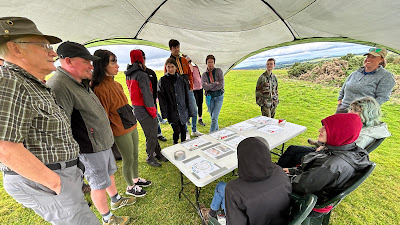
Explaining the finds on Dun Ailinne.


NOTE: Dun Ailinne is on a private working farm and not open to the public.

Photographs use Policy — Privacy Policy

Sunday, July 06, 2025

Dun Ailinne Open Day 2025 today


A reminder that the annual Open Day at the Dun Ailinne excavations will be TODAY, Sunday, 6 July, from 1pm-4pm, writes Brian Byrne. Dr Susan Johnston will give site tours at 1.30pm and 3pm.
A fee of €5 will be charged, which will be donated to charity. The event is by kind permission of the Thompson family, as the site is part of their working farm.
Dr Johnston, who is based at the Department of Anthropology at George Washington University, has been investigating the site since 2006. With colleague Dr Suzanne Garrett, she has led teams of American archaeology students on summer digs on Dun Ailinne since 2016, in association with the Black Friary Archaeological School in Co Meath. The students gain practical field experience on the site as well gaining an introduction to archaeology of Europe.

Photographs use Policy — Privacy Policy

Thursday, July 03, 2025

Dun Ailinne Open Day 2025 next Sunday

Dr Susan Johnston explaining a detail last year.

A reminder that the annual Open Day at the Dun Ailinne excavations will be next Sunday, 6 July, from 1pm-4pm, writes Brian Byrne. Dr Susan Johnston will give site tours at 1.30pm and 3pm.
A fee of €5 will be charged, which will be donated to charity. The event is by kind permission of the Thompson family, as the site is part of their working farm.
Dr Johnston, who is based at the Department of Anthropology at George Washington University, has been investigating the site since 2006. With colleague Dr Suzanne Garrett, she has led teams of American archaeology students on summer digs on Dun Ailinne since 2016, in association with the Black Friary Archaeological School in Co Meath. The students gain practical field experience on the site as well gaining an introduction to archaeology of Europe.
The late Professor Bernard Wailes carried out original excavations on Dun Ailinne in the late 1960s and early 1970s, and Dr Johnston was the co-author with him of a book on that work, published  in 2007. In 2008, the 'spear' monument, commissioned from the late sculptor Noel Scullion by Kilcullen Community Action, was dedicated as the centrepiece of the Dun Ailinne Interpretive Park in Kilcullen with Professor Wailes in attendance.
Dr Susan Johnston and Dr Suzanne Garrett.

Next Sunday's event is an opportunity to see and hear an update on the findings at a place of major historical significance and which is on the Tentative List for consideration as a UNESCO World Heritage Site as one of the ancient Royal Sites of Ireland.
Dun Ailinne is on a private working farmland, not open to the public, and investigations of the site are thanks to the courtesy of the Thompson family.

Photographs use Policy — Privacy Policy

Sunday, July 07, 2024

Strong turnout hears update on Dun Ailinne


Despite threatening thundershowers — some of which could be seen from the hill pouring rain over Kilcullen — there was a strong turnout for this afternoon’s Open Day on Dun Ailinne, writes Brian Byrne.
Hosted on the site by archaeologists Dr Susan Johnston and Dr Suzanne Garrett, courtesy of the Thompson family owners of the land, also on hand were eight students of archaeology who have been experiencing the vagaries of Irish weather over the last three weeks, to help explain the intricacies of the current excavations.
Dr Johnston led two tours of the site during the afternoon, explaining the context of the latest round of investigations against the background of the original excavations by the late Professor Bernard Wailes begun in the late 1960s, and the current explorations initiated by her in 2006. 
Dr Johnston is based in the Department of Anthropology at George Washington University and since 2016 she has led teams of American archaeology students, who gain practical field experience on the site as well gaining an introduction to archaeology of Europe. Professor Pam Crabtree of New York University, who worked on the original excavations undertaken by Bernard Wailes, has also been a key part of the current Dun Ailinne investigations.
The 2024 student cohort includes five from Dr Johnston’s university, one each from the University of Gettysburg and New York University, and an Irish student. Their participation is facilitated by the Black Friary Archaeological School in Co Meath.
Those who came on site today heard that the work this year has continued to yield more knowledge on the complex set of structure which have been gradually revealed over the years. What could have been dry historical information was imparted with the humour that likely makes Dr Johnston’s lectures in George Washington University both entertaining and unmissable.
She noted that while there were similarities in the form of the structures on Dun Ailinne with those on other Irish ‘Royal’ sites, they seem to be unique to Ireland, with no equivalents either in Britain or in continental Europe. She said the excavations have shown evidence of circular structures built outside each other at successive times. Carbon-dating which is currently being prepared for publication suggests the period of activity at Dun Ailinne could be around 300 years.
Dun Ailinne is the largest pre-Norman earthen enclosure in Ireland, covering some 44 acres. The ditch or 'henge' which circumscribes it is the best preserved and largest such feature in Ireland. 
A €5 donation per person from the Open Day is being given to the Jack and Jill Foundation.
NOTE: The Dun Ailinne site is on private land and a working farm, and is not open to the public. Permission for any visit to it must be obtained from the Thompson family, who have kindly facilitated the investigations to date. 


Photographs use Policy — Privacy Policy